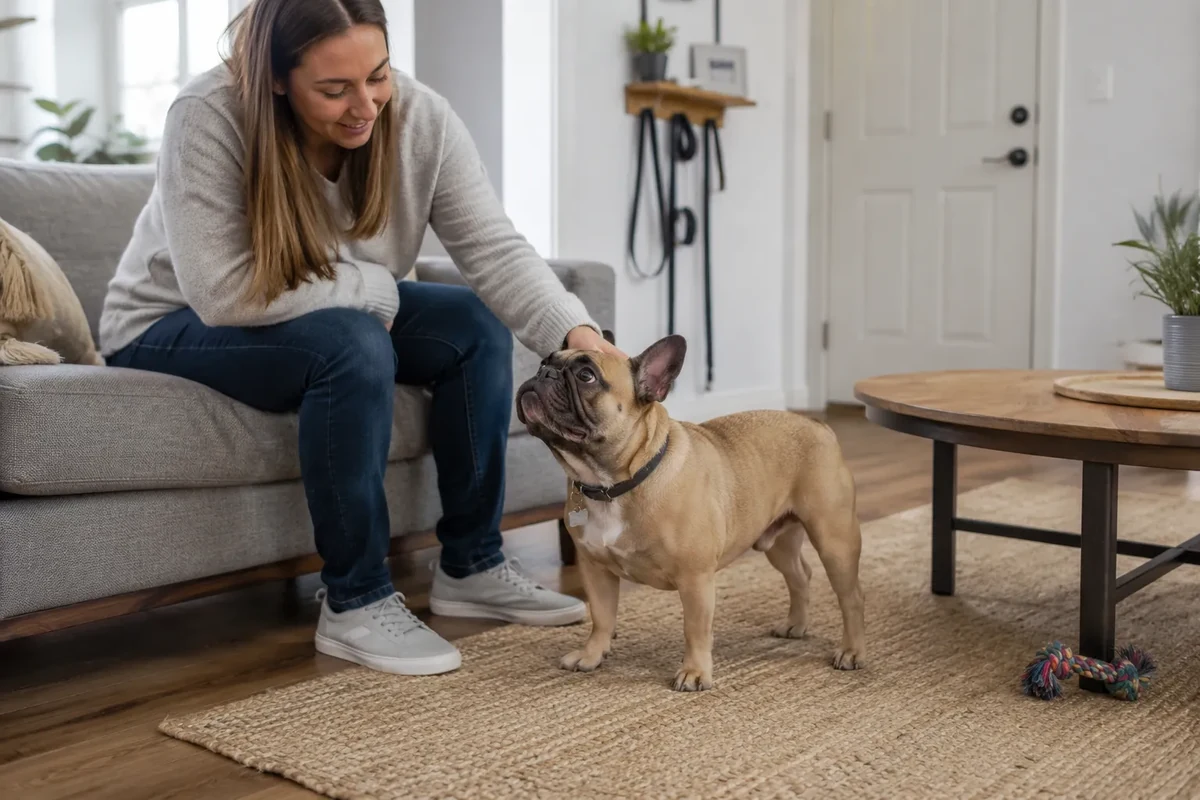
French Bulldogs make a convincing first impression.
They are small enough for an apartment, do not need a huge yard, have a short coat, and usually want to be wherever their people are. They can be playful without requiring the lifestyle of a high-drive sporting dog.
That combination explains a lot of their appeal.
The part that deserves more attention comes later.
A French Bulldog is a brachycephalic, or short-faced, breed. That affects breathing, heat tolerance and the kind of exercise that makes sense. Their compact body can come with other health considerations too. The short coat is simple to maintain, but facial folds still need attention, and a small dog does not automatically mean a cheap dog to own.
So the real question is not whether Frenchies are charming.
That part is easy.
It is whether their particular set of needs works for your household.
Small Size Is a Genuine Advantage
The French Bulldog breed standard puts the maximum weight at 28 pounds, which makes this a very manageable size for many homes.
A Frenchie does not require a giant crate.
The dog fits comfortably into most cars.
It takes up much less physical space than a Labrador Retriever, Golden Retriever or German Shepherd.
And if you live in a condo or apartment, simply moving through the building with a 20-something-pound dog is easier than doing the same thing with an 80-pound one.
Small size also makes some ordinary situations simpler.
You are not trying to hold back a large dog at the front door.
A modest living room does not suddenly feel occupied by an entire second piece of furniture.
That practicality is one of the breed's strongest advantages.
But small does not mean fragile little ornament.
The French Bulldog standard describes a compact, muscular, heavy-boned dog with an active, alert and playful temperament.
Apartment Life Can Work Very Well
Frenchies are often a sensible option for urban households.
They do not need acres of land, and their exercise requirements are generally more manageable than those of larger sporting or working breeds.
A short walk, some outdoor time and play can form part of an appropriate routine for a healthy individual.
That makes them easier to fit into city life than a dog whose normal routine demands long runs or hours of vigorous outdoor work.
There is still a catch.
An apartment dog has to go outside.
It still needs bathroom breaks.
It still needs things to do.
And a Frenchie that enjoys company does not automatically become content simply because the apartment has a comfortable couch.
Square footage is only part of the equation.
They Tend to Be Very People-Oriented
For someone who wants a companion dog, this is often the biggest selling point.
French Bulldogs tend to be affectionate, social and interested in what their people are doing.
That may mean following someone into the kitchen.
Sitting close while people watch television.
Wanting to participate when visitors arrive.
Or noticing immediately that somebody is preparing to leave the house.
For many owners, that is exactly what they wanted.
For someone who prefers a very independent dog, it may be less appealing.
A social dog also needs to learn that quiet time is normal and that people occasionally leave.
Teaching that gradually is much easier than waiting until the dog has spent months assuming that someone will always be available.
“Stubborn” Is Only Part of the Training Story
French Bulldogs regularly get described as stubborn.
That description is not completely invented, but it can become an excuse for poor training.
A Frenchie may simply need a reason to care about what you are asking.
Food can help.
Short sessions can help.
Clear repetition helps.
Arguing with the dog for ten minutes generally does not improve anything.
For normal household life, the important skills are ordinary ones:
- coming when called;
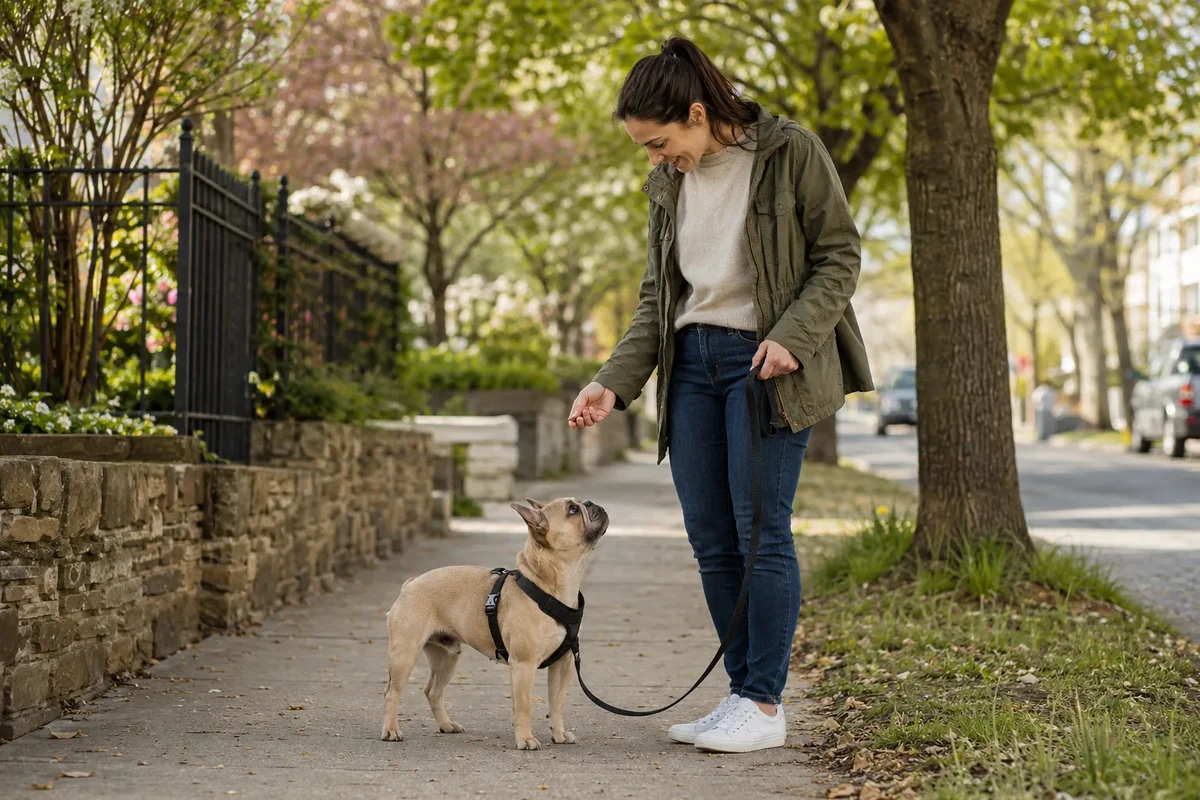
- walking reasonably on a leash;
- waiting at doors;
- settling when asked;
- tolerating routine handling;
- leaving things alone;
- behaving appropriately around visitors.
You do not need a competition obedience dog.
You do need a small dog with enough manners that “cute” is not doing all the work.
House Training May Require Patience
Small companion breeds sometimes get away with inconsistent house-training routines longer than large dogs do.
A small accident is easier to tolerate.
That does not make it useful.
A predictable routine, supervision, reinforcement for going in the correct place and reasonable access to bathroom breaks are much more effective than repeatedly discovering what happened after the fact.
Weather can make this more annoying.
Some Frenchies are less enthusiastic about going outside in rain, cold or heat.
The answer is still routine.
Not a negotiation at the back door every time the weather becomes mildly inconvenient.
Exercise Matters, but More Is Not Always Better
French Bulldogs are not endurance dogs.
That distinction matters.
Most healthy Frenchies still benefit from regular moderate activity.
A normal routine may include walking, indoor play, easy outdoor play and training.
What it should not become is an attempt to turn a Frenchie into a distance-running partner.
The individual dog matters too.
A fit French Bulldog with good respiratory function may tolerate activity very differently from one with airway problems.
Age, weight, orthopedic health, temperature and humidity all change what is reasonable.
That is why universal rules like “Frenchies can only walk for 15 minutes” are not very helpful.
Watch the dog, the conditions and the breathing.
Breathing Deserves More Attention Than the Snoring Jokes Suggest
This is probably the most important part of choosing the breed.
French Bulldogs are brachycephalic.
Their short facial structure can make breathing less efficient than it is in longer-muzzled dogs, and the breed has less tolerance for heat, strenuous exercise and other situations that increase respiratory demand.
Some Frenchies make respiratory noises.
That does not mean every loud breathing sound should be dismissed as:
“That's just what Frenchies sound like.”
OFA's Respiratory Function Grading Scheme exists specifically because brachycephalic obstructive airway syndrome, or BOAS, can interfere with exercise, eating, sleeping and normal quality of life.
Persistent loud breathing, obvious breathing effort, unusually poor exercise tolerance, collapse or other signs of respiratory difficulty deserve veterinary attention.
A cute snore should never become a reason to ignore a dog that is struggling to breathe.
Heat Is a Bigger Deal With This Breed
Dogs rely heavily on panting to lose heat.
Short-faced breeds can be less efficient at doing that, which makes French Bulldogs more vulnerable when temperature, humidity and physical effort rise together.
This affects ordinary summer life.
A walk that was completely reasonable on a cool morning may be a poor choice on a hot afternoon.
A Frenchie should not be pushed to keep up with a longer-muzzled athletic dog simply because both dogs are willing to continue moving.
Shade matters.
Air conditioning can matter.
The time of day matters.
Watching the dog's breathing matters.
This is one of those breed characteristics that actually changes how you plan the day.
If you live somewhere with long, hot summers, take it seriously before choosing the breed rather than assuming you will figure it out later.
Short Coat Does Not Mean No Grooming
French Bulldog coat care is simple compared with a Poodle or Golden Retriever.
The coat is short and smooth.
There is no haircut to maintain.
There is no long feathering to untangle.
Routine brushing can help remove loose hair and keep an eye on the skin.
Bathing is needed when appropriate for the individual dog rather than because a calendar says it is Saturday.
That is the easy part.
The face requires a little more thought.
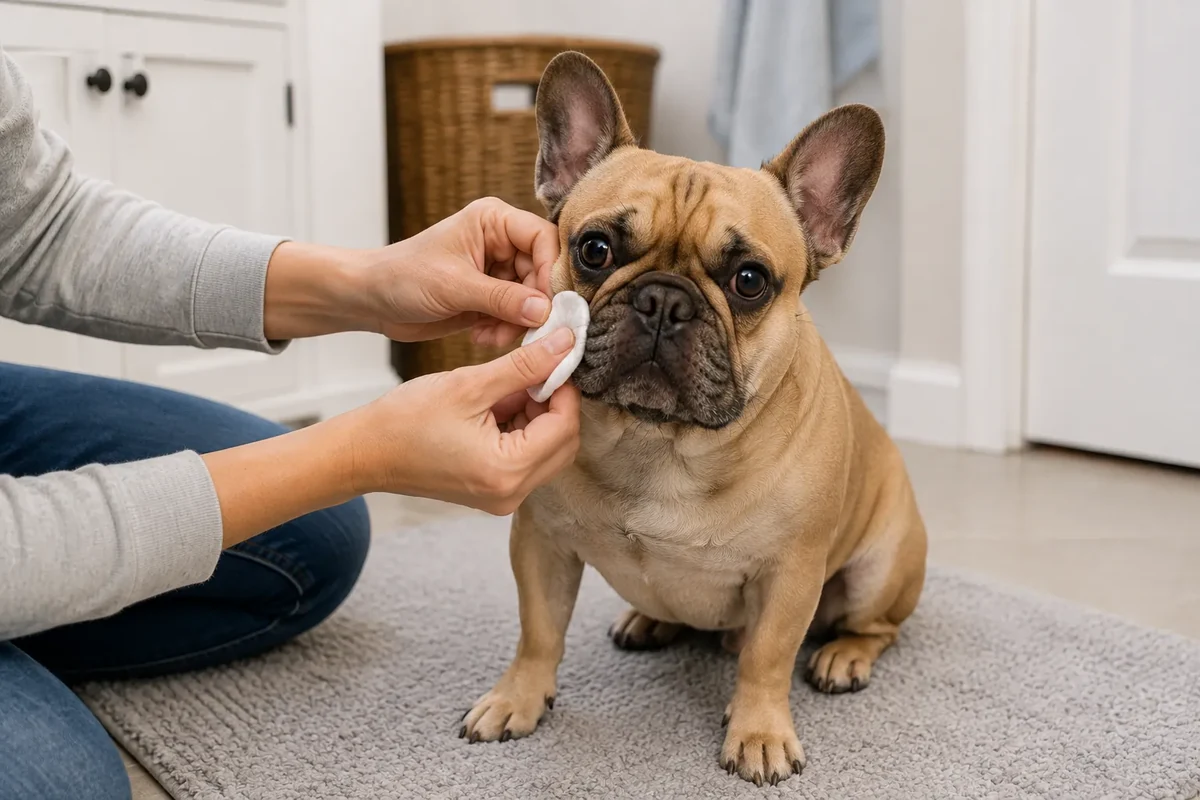
Facial Folds Need to Stay Clean and Dry
Frenchies have facial wrinkles, and moisture and debris can collect where skin touches skin.
That means folds should be checked regularly and kept clean and dry.
It does not mean every French Bulldog needs the exact same daily cleaning ritual.
Some dogs need more frequent attention than others.
The useful thing is to know what normal skin looks and smells like.
If a fold becomes persistently red, sore, damp, smelly or produces discharge, continuing to scrub it at home is not necessarily the solution.
That is a good time to involve a veterinarian.
They Do Shed
A French Bulldog is not a non-shedding dog.
The short coat simply makes the experience different from living with a Golden Retriever or German Shepherd.
You are less likely to find long clumps of feathering rolling across the floor.
Instead, short hairs can turn up on clothing, furniture, bedding and car upholstery.
For many households, the amount is manageable.
But if your goal is a dog that leaves virtually no visible hair around the house, a Frenchie does not provide that guarantee.
Our Poodle Pros and Cons guide covers a very different coat tradeoff: much less visible shedding, but far more coat maintenance.
Kids and Frenchies Can Be a Good Match
French Bulldogs can fit very comfortably into family life.
Their compact size is convenient, and they are generally social companion dogs rather than animals bred for intense independent work.
But small size is not permission for children to treat the dog like a toy.
A Frenchie still needs space to rest, privacy while eating, gentle handling, and supervision around young children.
Children should not climb on the dog, pull ears, disturb sleep or repeatedly corner a dog that is trying to move away.
The same rule applies to every breed.
A friendly reputation is helpful.
Respectful interaction is still necessary.
Other Pets Depend on the Individual Dog
Many French Bulldogs can live happily with other dogs and cats.
Others may be more selective.
Early experience, introductions and individual temperament matter.
Do not assume that because a Frenchie loves people it will automatically love every dog it meets.
And do not expect an older resident pet to appreciate an enthusiastic Frenchie puppy simply because the puppy means well.
Slow introductions and good management are easier than repairing a bad first week.
Water Needs More Caution Than It Does With a Labrador
French Bulldogs are not a breed to casually leave around a swimming pool.
Their compact, front-heavy build can make swimming difficult.
That does not mean every Frenchie instantly sinks.
It means you should not assume swimming ability.
Pools, docks, boats and open water require supervision.
A properly fitted canine flotation device can provide another layer of protection when a Frenchie is around deeper water, but it does not replace supervision.
This is one of those small practical details that matters much more once the dog actually lives in your house.
Health Screening Should Be Part of the Puppy Search
If you are buying a French Bulldog puppy, health testing deserves more attention than coat color.
The French Bull Dog Club of America currently requires hip, eye, patella and cardiac results for its CHIC program and recommends several additional evaluations, including respiratory function grading.
Ask for the actual results.
Not:
“The parents are perfectly healthy.”
Not:
“We've never had a problem.”
Documented screening and a breeder's opinion are two different things.
You can also look up OFA results where available rather than relying entirely on a screenshot sent by the seller.
Ask About Breathing Too
For French Bulldogs, this deserves its own conversation.
OFA now offers official Respiratory Function Grading Scheme certification in North America, including for French Bulldogs.
That gives prospective owners something much more useful to ask about than:
“Does the dad snore?”
Ask whether breathing function has been assessed.
Ask how the parents tolerate normal activity.
Ask about respiratory problems in close relatives.
There is no health test that can guarantee a perfect puppy.
But actual information is still better than choosing a breeder entirely by puppy photos.
More Extreme Is Not Better
Frenchies are recognizable because of their short faces and large ears.
That does not mean the best puppy is the one with the most exaggerated possible features.
When comparing breeders, functional health should matter more than achieving the flattest-looking face on social media.
The breed standard itself calls for overall balance and says no single feature should be so exaggerated that the dog appears poorly proportioned.
A French Bulldog still needs to live as a dog.
Walk.
Play.
Sleep comfortably.
Eat.
Breathe.
Those things matter more than making one physical trait as extreme as possible.
Veterinary Costs Deserve Some Planning
It would be unfair to say every French Bulldog will become a medical disaster.
That is not true.
It would also be unwise to choose the breed without thinking about veterinary expenses.
Respiratory issues, orthopedic problems, spinal concerns, skin problems and other conditions occur in the breed.
You do not have to buy pet insurance.
But you do need a financial plan.
That could be insurance.
It could be a dedicated emergency fund.
It could be another realistic way to handle an unexpected veterinary bill.
The correct option depends on your finances.
Pretending the possibility does not exist is the one option that is consistently unhelpful.
They Aren't Expensive Because They Eat a Lot
Food is not usually the largest breed-specific expense.
A Frenchie is small.
The bigger questions are often medical care, responsible breeding costs, training and normal dog expenses.
Crate.
Bed.
Harness.
Veterinary visits.
Preventive medications.
Pet care when you travel.
Possibly professional help with grooming or training.
A small dog can absolutely cost more over its lifetime than a larger dog with fewer health complications.
Size and ownership cost do not always move together.
First-Time Owners Can Do Well With French Bulldogs
A Frenchie does not require an experienced working-dog handler.
The breed is compact, generally social and often quite trainable with good motivation.
That can make one a manageable first dog.
But first-time owners need to understand the health side of the breed.
You need to recognize that hot weather matters more.
You need to pay attention to breathing.
You need to choose a breeder carefully if buying a puppy.
You still need house training, leash manners and basic obedience.
The day-to-day dog is not necessarily difficult.
The breed-specific decisions require a little more thought than the small body suggests.
Who Usually Enjoys Living With a Frenchie?
A French Bulldog can make a lot of sense for someone who wants a smaller companion and actually enjoys having the dog nearby.
You may appreciate the breed if you want a compact dog, moderate rather than extreme exercise demands, a short coat, a social companion, a dog that can fit into urban life, and a playful personality without the scale of a Labrador.
You also need to be comfortable adapting activity to temperature and to the individual dog's breathing and health.
That last part is not optional fine print.
It belongs in the main decision.
Who Should Think Twice?
A Frenchie deserves more consideration if you want a running partner.
Or a dog that can comfortably join strenuous outdoor activities in hot weather.
Or a reliable swimmer.
Or a breed where respiratory function is unlikely to become part of the health conversation.
Think carefully too if veterinary costs would be extremely difficult for your household to absorb.
And if what attracts you most is an extremely flat face, rare color or exaggerated appearance, spend some time learning about functional health before choosing a puppy.
There are easier breeds to select based mostly on looks.
French Bulldogs are not one of them.
French Bulldog FAQ
Are French Bulldogs good apartment dogs?
They often can be. Their compact size and moderate exercise needs work well in smaller homes. Owners still need to provide bathroom breaks, walks, play, training and social interaction, and warm-weather activity has to be managed carefully because of the breed's brachycephalic anatomy.
Do French Bulldogs need a lot of exercise?
They need regular activity, but they are not endurance dogs. Most healthy Frenchies can participate in moderate exercise, while strenuous activity—particularly in hot or humid weather—requires more caution. Individual breathing function, fitness, age and health all matter.
Is snoring normal for a French Bulldog?
Some Frenchies make more respiratory noise than longer-muzzled dogs, but loud or difficult breathing should not automatically be dismissed as normal. BOAS can affect breathing, exercise, eating and sleep, and clinically affected dogs may need veterinary care.
Do French Bulldogs shed?
Yes. They have short, smooth coats and do shed. Routine brushing can help manage loose hair, but Frenchies are not a non-shedding breed. Their short hair simply looks different around the home than the longer coat shed by breeds such as Golden Retrievers.
Are French Bulldogs difficult to train?
Not necessarily. They can have an independent streak, but many Frenchies are very trainable with appropriate motivation. Consistency and reward-based training usually make more sense than treating “stubborn” as an unchangeable breed trait.
Are French Bulldogs good with children?
They can fit well into family homes, but individual temperament and supervision still matter. Children should be taught to interact respectfully with the dog and leave it alone when it is eating, sleeping or trying to move away.
Can French Bulldogs swim?
Do not assume they can. Their compact, front-heavy build can make swimming difficult, so they should be closely supervised around pools and other water.
What health tests should a French Bulldog breeder have?
The French Bull Dog Club of America currently lists hip, eye, patella and cardiac evaluations as required CHIC screenings and recommends additional tests, including respiratory function grading. Ask to see or verify actual test results rather than relying only on a verbal assurance that the parents are healthy.
Is a French Bulldog Right for You?
There are plenty of reasons French Bulldogs have become so popular.
They are compact.
They fit easily into many homes.
They tend to enjoy people.
They do not need the same exercise schedule as a Labrador or German Shepherd.
And when you want a dog that is happy to be part of ordinary household life, a Frenchie can be a very appealing companion.
The health side changes the calculation.
Breathing cannot be treated as a joke.
Heat matters.
Water requires caution.
Breeder selection deserves real work.
And choosing a small dog does not guarantee small veterinary expenses.
For someone who understands those limits and wants a close, compact companion, the tradeoff may make sense.
For someone who wants a rugged little dog that can exercise hard in any weather with minimal health considerations, it probably does not.
The French Bulldog's best qualities do not disappear when you talk seriously about its limitations.
Knowing both sides is what makes the choice useful.