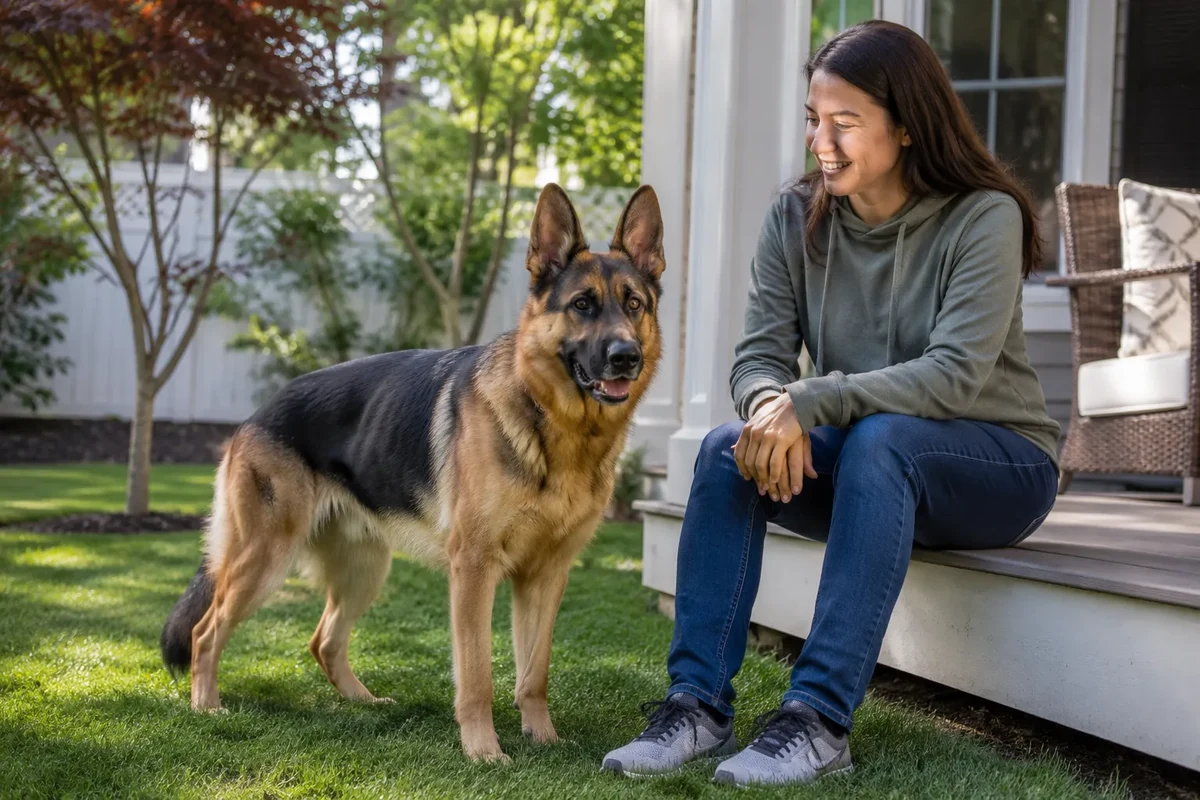
German Shepherds are easy dogs to admire.
They are big, athletic, alert, and unusually good at learning what people want from them. There is a reason the breed turns up in everything from family homes to search-and-rescue work.
That reputation can also create the wrong picture.
A German Shepherd is not automatically a perfectly trained family guardian that spends the afternoon lying quietly by the front door.
It is a large working dog.
That means training matters. Exercise matters. Socialization matters. The amount of hair coming off the dog definitely matters.
For the right household, those things are manageable and often part of the appeal.
For the wrong one, a German Shepherd can be much more dog than expected.
Start With the Actual Size of the Dog
German Shepherds are substantial dogs.
Adult males are generally around 24 to 26 inches at the shoulder and often weigh about 65 to 90 pounds. Females are usually around 22 to 24 inches and roughly 50 to 70 pounds.
That affects everyday life more than a breed photo makes obvious.
A 75-pound dog takes up space in the car.
It can pull hard if leash training has been neglected.
It costs more to feed than a small dog.
Bathing one is a real project.
And when an excited young German Shepherd comes through the hallway too fast, everyone notices.
The breed's expected lifespan is roughly 12 to 14 years, so choosing one is a fairly long commitment to living with a large, active dog.
Training Is One of the Best Parts of Owning One
German Shepherds generally learn quickly.
That is a genuine advantage.
Basic obedience, leash work, recall, scent games, retrieving, tricks, structured play — there is a lot you can do with a dog that pays attention and likes having a job.
Training also makes daily life easier.
Teaching a large dog to wait at doors, walk without dragging you down the sidewalk, settle when asked, and come when called is not just about showing off obedience skills.
It changes what the dog is like to live with.
The catch is simple:
A dog that is good at learning still needs somebody to teach it.
German Shepherds do not arrive preprogrammed.
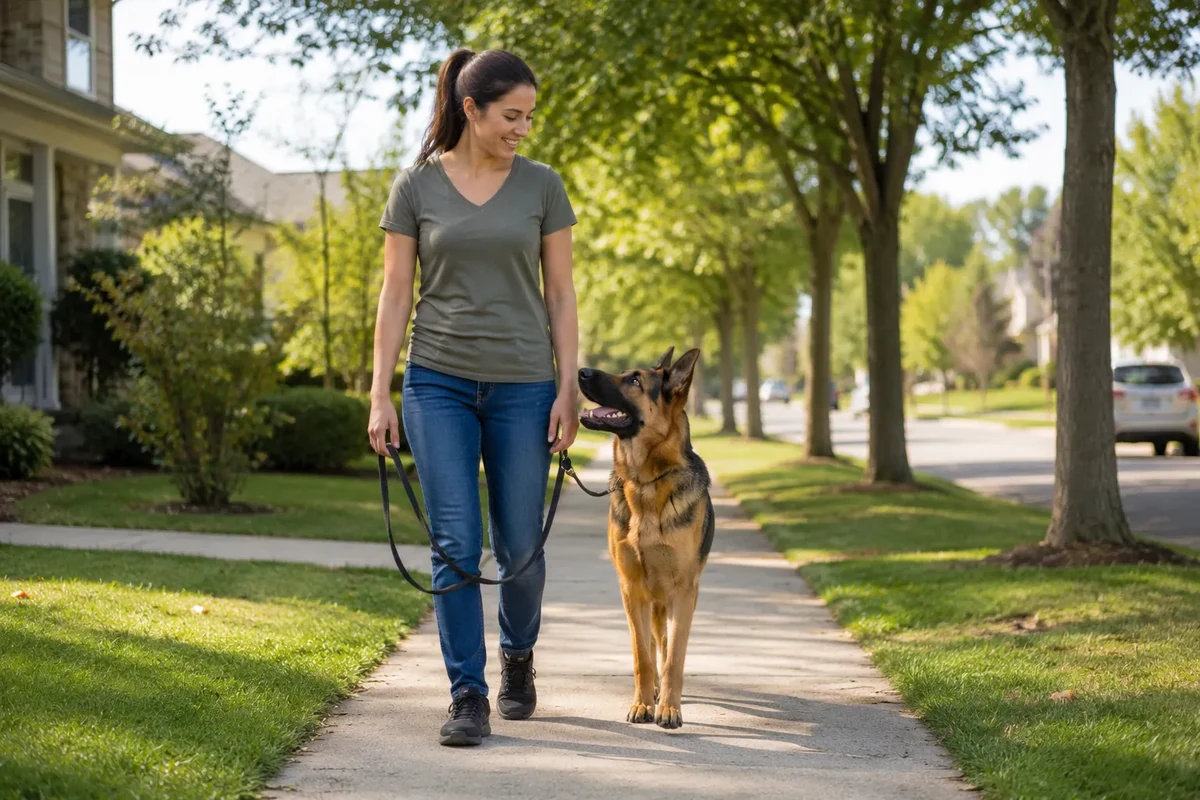
Smart Dogs Pick Up Bad Habits Too
This is where people sometimes get caught out.
A German Shepherd may learn sit in a few minutes.
It can also learn that barking gets someone to come to the window.
Or that grabbing a shoe starts an exciting chase through the house.
Or that pulling toward another dog works if the person on the other end of the leash eventually gives in.
Intelligence makes training easier when the household is consistent.
It can make life more complicated when nobody has decided what the rules actually are.
That does not mean you need to spend all evening drilling obedience.
It does mean a GSD usually does better in a home where people are willing to keep teaching the dog as it grows.
They Usually Want More Than a Walk Around the Block
German Shepherds were developed as working dogs.
You can still see that in ordinary pets.
A healthy adult often wants a combination of physical exercise and something mentally interesting to do.
A long walk is useful.
A walk where the dog gets to sniff and explore is better.
Add a few minutes of training, retrieving, searching for something, or another simple activity and you have given the dog much more to work with.
The exact amount varies.
A young adult German Shepherd is not the same dog as a ten-year-old with arthritis.
There is no useful universal formula saying every GSD needs exactly 90 minutes of exercise.
But if your ideal dog gets one quick bathroom walk in the morning and then spends the rest of the day entertaining itself, this probably is not the breed to choose.
A Backyard Helps. It Doesn't Solve the Problem.
A fenced yard is convenient with a German Shepherd.
The dog can go outside without every bathroom break becoming a walk.
There is room for play.
It makes some parts of daily life easier.
But putting a working breed in a backyard does not automatically exercise it.
Plenty of dogs with big yards spend most of their time standing near the back door waiting for someone to come outside.
German Shepherds generally need interaction, not just acreage.
That is also why apartment living is not automatically impossible.
It simply puts more responsibility on the owner.
If a GSD living in an apartment gets appropriate walks, training, play, bathroom breaks, and mental activity, the lack of a private yard is not the only thing that matters.
The harder question is whether you can reliably provide those things every day.
Their Relationship With Strangers Is Often Misunderstood
German Shepherds are not supposed to behave like Golden Retrievers with every person they meet.
A confident adult may be somewhat reserved around strangers.
That can be completely normal.
Reserved does not mean frightened.
It does not mean lunging at visitors.
And it does not mean a dog should be encouraged to act threatening because someone likes the idea of owning a “protector.”
A stable German Shepherd should be able to exist around unfamiliar people without falling apart.
That is one reason early socialization matters so much.
The goal is not to force the puppy to love everybody.
It is to teach the dog that normal people, places, sounds, surfaces, vehicles, visitors, and everyday life are not emergencies.
Socialization Is More Than Meeting Other Dogs
A lot of owners hear the word socialization and picture a puppy playing at the dog park.
That is only a small part of it.
For a German Shepherd puppy, useful early experiences can include calmly encountering people of different ages, traffic, veterinary handling, new surfaces, household noises, visitors, busy sidewalks, car rides, other appropriate animals, and quiet time around distractions.
The point is not to overwhelm the puppy with as many experiences as possible.
It is to help normal life become normal.
With a large, naturally alert breed, that foundation becomes particularly valuable later.
The Family Bond Can Be a Big Plus
German Shepherds often become very attached to their households.
They notice routines.
They want to know where people are.
Many prefer being part of whatever the family is doing rather than spending the day completely on their own.
For people looking for an involved companion, that can be one of the breed's best qualities.
But it also means a GSD may not be ideal if your preferred dog is extremely independent and mostly keeps to itself.
A dog that likes being involved still needs to learn how to settle and spend some time alone.
Otherwise close attachment can turn into a dog that never learned what to do when nobody is available to entertain it.
What About Kids?
German Shepherds can live very successfully with children.
The usual conditions still apply.
Temperament matters.
Training matters.
The children's behavior matters.
And adults need to supervise interactions, especially with younger kids.
A large excited dog can knock a child down accidentally.
A child can also make a dog uncomfortable by climbing on it, grabbing it, cornering it, or bothering it while it is resting.
No breed label replaces teaching both sides how to behave.
The same goes for other pets.
Some German Shepherds live easily with cats and other dogs. Others have stronger chase behavior or are more selective.
Individual temperament and early experience matter much more than a simple “good with pets” checkbox.
Now for the Hair
If you hate loose dog hair, pay attention to this part.
German Shepherds have a double coat.
They shed.
Not just during one dramatic week in spring.
There can be loose hair throughout the year, with much heavier periods when the undercoat is changing.
That hair ends up in very ordinary places: on floors, against baseboards, under furniture, on clothing, inside the car, and on the couch if the dog is allowed up there.
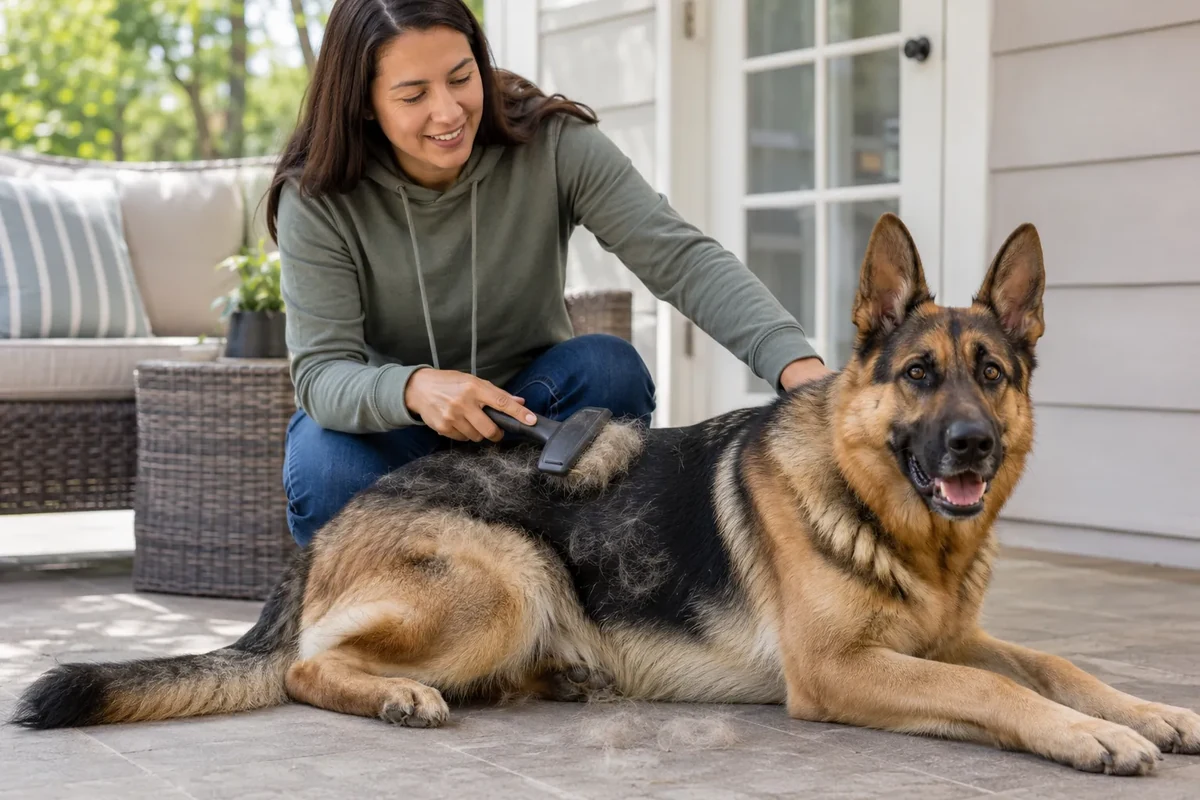
Regular brushing helps remove loose coat before some of it reaches the house.
It does not turn a German Shepherd into a low-shedding dog.
If you're comparing breeds partly because of household hair, this is almost the opposite of living with a Poodle. A Poodle generally leaves less visible loose hair around the home but requires much more clipping and coat maintenance. Our Poodle Pros and Cons guide covers that contrast from the other side.
The Coat Is Straightforward, but There Is a Lot of It
One advantage is that a German Shepherd normally does not need regular haircuts.
You are not maintaining a shaped clip.
There is no continuously growing curly coat to trim.
Routine care is more about brushing out loose coat, basic bathing when needed, nails, ears, teeth, and normal skin checks.
The work increases when the dog is shedding heavily.
During those periods, brushing can remove a surprising amount of loose undercoat.
More aggressive is not automatically better.
You are trying to remove coat that is ready to come out, not repeatedly scrape through healthy hair or skin.
And shaving a normal German Shepherd coat just to reduce household shedding is not a sensible shortcut.
The double coat has a purpose.
You Will Still Need to Clean the House
This sounds obvious, but it matters because some prospective owners underestimate the difference between grooming the dog and managing the home.
Even a regularly brushed German Shepherd will shed.
You may still vacuum frequently.
Hair tends to migrate toward room edges and underneath furniture.
Carpet can hold onto it.
Hard floors let it travel until it stops somewhere inconvenient.
If you already live with a heavy shedder, our Pet Hair Cleaning Guides cover carpet, stairs, hard floors, furniture edges, and other places where loose coat tends to collect.
The useful expectation is not “I'll brush the dog and there won't be hair.”
It is that brushing the dog and cleaning the home are both part of living with the breed.
German Shepherd Puppies Can Be a Lot
Adult German Shepherds often look composed in photographs.
Puppies are puppies.
Young GSDs can be energetic, mouthy, clumsy, curious, and surprisingly determined.
They grow quickly too.
A behavior that seems mildly annoying in a 20-pound puppy can become much more important once the dog is 60 pounds.
This is why early leash training, recall, handling, impulse control, and household rules are worth working on before the dog becomes physically powerful.
Adolescence can also test whatever training appeared perfect a few months earlier.
That is normal development, not evidence that the dog suddenly forgot everything.
Keep training.
Choosing the Breeder Matters More Than Choosing the Prettiest Puppy
If you are buying rather than adopting, the breeder deserves serious attention.
German Shepherd temperament and health should not be an afterthought.
Ask about health testing of the parents.
For this breed, hip and elbow evaluations are particularly important.
Responsible breeding programs may also use additional health testing and temperament evaluation.
Do not be satisfied with “Both parents are healthy.”
A dog can look completely healthy and still carry or develop inherited problems that proper screening is intended to reduce.
You also want to know what the breeder is trying to produce.
Not every German Shepherd line is identical in drive, energy, structure, or temperament.
A puppy bred for intense working performance may not be the easiest match for a household simply looking for an active family companion.
Ask questions before choosing the puppy, not after bringing it home.
Health Is Another Reason to Plan Ahead
German Shepherds can be affected by inherited orthopedic and other health problems.
Hip and elbow issues are among the best-known concerns, which is why screening breeding dogs is important.
That does not mean every German Shepherd will develop serious joint disease.
It does mean “this breed sometimes has bad hips” is not something to discover for the first time after buying a puppy from parents that were never evaluated.
Routine veterinary care, maintaining an appropriate body condition, suitable exercise, and choosing responsibly bred dogs all matter.
If your dog develops pain, weakness, digestive problems, skin issues, or another persistent change, that is a veterinary question rather than something to diagnose from a breed article.
Are German Shepherds Good First Dogs?
They can be.
But they are not an especially forgiving choice for someone who wants to put very little effort into learning how dogs work.
A motivated first-time owner can absolutely raise a good German Shepherd.
The person needs to be prepared for a large adult dog, regular training, socialization, significant exercise, heavy shedding, possible barking, veterinary and food costs, and a puppy that becomes strong surprisingly quickly.
Previous dog ownership is less important than willingness to actually do those things.
Someone who has owned five dogs but never trained any of them may be less prepared than a first-time owner who takes the job seriously.
They Can Be Vocal
German Shepherds notice things.
That can include delivery drivers, neighbors, people walking past the house, dogs outside, doors closing, and sounds you had successfully ignored for years.
Some individuals are naturally more vocal than others.
Training can help teach when barking is unnecessary and how to settle after noticing something.
But if you need a dog with almost no tendency to alert bark, a German Shepherd is not the most obvious choice.
This is especially worth thinking about in an apartment or tightly packed neighborhood.
The Cost Is More Than the Purchase Price
Large dogs cost more in ordinary ways.
Food is one.
Preventive veterinary care and medication can cost more because dosing often depends on size.
Crates, beds, harnesses, boarding, and other equipment also tend to become more expensive as the dog gets larger.
German Shepherds do not have the regular professional clipping costs of a Poodle, but that does not make them cheap dogs.
If you are budgeting for one, think in terms of maintaining a 50- to 90-pound animal for years, not just paying for the puppy.
Who Usually Does Well With a German Shepherd?
This breed often works best for someone who likes doing things with their dog.
You do not need to be a marathon runner.
You do need to be comfortable with an animal that benefits from training and involvement.
A good match is often a household willing to exercise the dog regularly, teach clear household rules, continue training beyond puppy class, manage a lot of loose hair, socialize thoughtfully, budget for a large dog, and include the dog in everyday life.
You also need to be comfortable owning a dog that strangers may perceive differently from a small companion breed.
Good public manners matter.
Who Should Think Twice?
A German Shepherd probably deserves a second thought if the biggest things you want from a dog are low shedding and low daily involvement.
The same applies if you strongly dislike training.
Or if walking a large powerful dog would be physically difficult.
Or if the dog will regularly be left with little exercise and almost nothing to do.
And if the main reason you want one is “I want a dog that will protect me,” that is not enough.
You still have to live with the dog during the thousands of ordinary hours when nobody needs protecting.
Those hours matter much more.
German Shepherd FAQ
Do German Shepherds shed a lot?
Yes. German Shepherds have a double coat and can shed heavily, particularly when the undercoat changes seasonally. Regular brushing helps remove loose coat, but owners should still expect dog hair around the home.
Are German Shepherds aggressive?
A well-bred German Shepherd should not be indiscriminately aggressive. The breed is often naturally reserved with strangers, but confidence and calm behavior are different from fear or hostility. Genetics, socialization, training, and the individual dog all affect adult behavior.
Are German Shepherds good family dogs?
They can be excellent family companions in the right home. They are large dogs, however, so training, child supervision, socialization, and appropriate outlets for exercise all matter.
Can a German Shepherd live in an apartment?
Yes, but apartment living puts more responsibility on the owner to provide exercise, training, bathroom breaks, and mental activity outside the home. A private yard is convenient, but it is not a substitute for those things either.
How much exercise does a German Shepherd need?
There is no useful one-size-fits-all number. Healthy young adults are generally active dogs and benefit from regular physical exercise plus training or other mental activity. Age, health, temperament, and individual energy level all affect the amount needed.
Are German Shepherds good for first-time owners?
They can be, provided the owner understands that this is a large working breed that needs training, socialization, exercise, and consistent involvement. They are less suited to someone looking for an especially hands-off first dog.
Do German Shepherds need professional grooming?
Usually not for routine coat trimming. Their double coat normally needs regular brushing rather than haircuts. Professional grooming can still be useful for bathing, nails, coat blow-outs, or other maintenance if an owner prefers not to do those jobs at home.
So, Is a German Shepherd Right for You?
German Shepherds have a lot going for them.
They learn quickly.
They can be deeply connected to their families.
They are athletic enough to do far more than circle the neighborhood once a day.
And for people who enjoy training, there is a lot of dog to work with.
The downsides are equally real.
They are large.
They shed heavily.
They need exercise and mental engagement.
Poor socialization is much harder to ignore in a powerful dog than in a tiny one.
And buying from a breeder without paying attention to health and temperament can create problems that enthusiasm alone will not fix.
A good German Shepherd is not difficult because the breed is somehow extreme.
It is demanding because the things that make the breed appealing — intelligence, size, alertness, athleticism, willingness to work — all need somewhere sensible to go.
If that sounds like the kind of dog you want to live with, the work may be worth it.
If you mostly want the appearance and reputation of a German Shepherd without the daily job that comes with one, another breed is probably a better choice.