
Golden Retrievers have one of the easier reputations in the dog world.
Friendly. Trainable. Good with families. Happy to go places with you. Usually thrilled that a person has entered the room, even if that person is there to fix the dishwasher.
Most of that reputation is deserved.
What tends to get left out is the amount of dog attached to all that friendliness.
An adult Golden Retriever is not small. The coat sheds. Young Goldens can be busy, mouthy, enthusiastic, and convinced that every object within reach deserves investigation. They need exercise, training, grooming, and a fair amount of time with their people.
For many households, those are easy tradeoffs.
But “nice dog” and “easy dog” are not quite the same thing.
A Golden Retriever Takes Up More Space Than the Photos Suggest
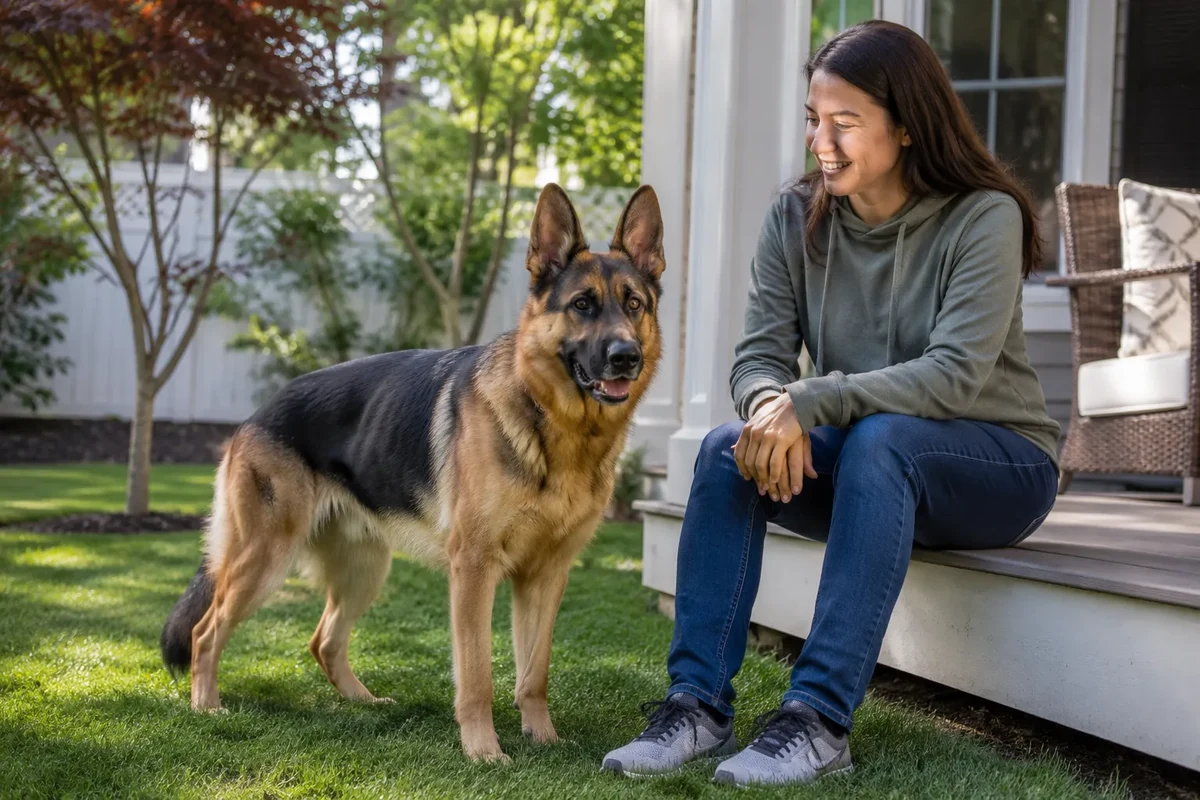
Adult males are generally around 23 to 24 inches at the shoulder and 65 to 75 pounds. Females are usually about 21.5 to 22.5 inches and 55 to 65 pounds.
That is a useful thing to picture before you fall in love with a puppy.
A 70-pound Golden takes up a decent section of the back seat.
It can clear a coffee table with one enthusiastic tail.
A dog that jumps on visitors at 15 pounds becomes a different problem at 60.
Beds, crates, food, medications, boarding, grooming, and car space all become larger-dog expenses.
Goldens are often very approachable dogs, so people sometimes forget that they still need the same basic manners you would expect from any other strong, medium-to-large breed.
Friendly pulling is still pulling.
Friendly jumping is still jumping.
The Friendly Personality Is a Real Advantage
This is probably the part people get right most often.
Golden Retrievers were bred to work closely with people, and many modern Goldens still seem happiest when they are part of whatever the household is doing.
That might mean going for a walk.
It might mean carrying something around while you work in the yard.
It might simply mean sleeping nearby while everyone watches television.
They are generally not known for treating every unfamiliar person as a serious threat, which can make normal social life easier than with a breed that is naturally much more reserved.
Visitors, family gatherings, outdoor activities, training classes and trips can all fit comfortably into life with a well-socialized Golden.
Of course, breed tendency is not a guarantee.
Every dog still has its own temperament.
They Usually Want to Be Where the People Are
The social side has a downside if you want a very independent dog.
A Golden Retriever may be perfectly capable of relaxing alone for reasonable periods after being taught how, but this is not generally a breed chosen because it prefers spending most of the day detached from its household.
Many want to follow activity around the house.
They notice when shoes go on.
They notice when the refrigerator opens.
They definitely notice when somebody picks up a leash.
That closeness is one of the things owners tend to love about the breed.
It also means you need to think seriously about your schedule.
A dog that regularly spends very long days with little company, little exercise and nothing interesting to do may find its own ways to pass the time.
Sometimes those ways involve things you wanted to keep.
Training Is Usually Pleasant — Once You Actually Do It
Goldens tend to be responsive dogs and often enjoy working with people.
That helps enormously with training.
Food rewards usually make sense to them. Play can work well. Retrieving comes naturally to many. They can learn household routines quickly and are widely used in activities that demand close cooperation with a handler.
But a good temperament does not arrive with a completed obedience course.
Young Goldens still need to learn how to walk on a leash, not to jump on everyone they like, to come when called, what they are allowed to chew, when to let go of something, how to settle down, and how to behave around visitors.
Those lessons become much easier if they begin while the dog is still small.
Waiting until an enthusiastic adolescent is physically strong enough to pull you across the sidewalk makes everything more complicated.
The Puppy Stage Can Be More Work Than Expected
Adult Golden Retrievers appear in a lot of family photos looking calm, soft and extremely pleased with life.
That is not necessarily what comes home at eight or ten weeks old.
Golden puppies explore with their mouths.
They can be energetic.
They can get overexcited.
Some seem to believe the floor is a buffet containing socks, napkins, mulch, children's toys and whatever fell behind the couch in 2024.
This is not a reason to avoid the breed.
It is a reason to puppy-proof the house and teach useful behaviors early.
Drop it, leave it, trading objects, appropriate chew toys, recall and calm handling are much more useful than discovering how fast you can chase a puppy carrying something expensive.
And the young-dog phase does not end simply because the puppy looks almost adult.
A full-size Golden can still have a very unfinished brain.
They Need Real Exercise
Golden Retrievers are sporting dogs.
They were not developed to spend an entire life walking from the sofa to the food bowl and back.
Healthy adults generally enjoy activity, and many are very good companions for people who like walking, hiking, retrieving, swimming or simply spending time outdoors.
That does not mean every Golden needs the exact same number of exercise minutes.
Age matters.
Health matters.
Individual energy level matters.
A young adult and a senior dog should not have identical routines.
What matters is that regular activity is part of the plan.
A quick trip outside for bathroom breaks is not the same thing as exercise.
Fetch Is Popular for a Reason, but It Isn't Mandatory
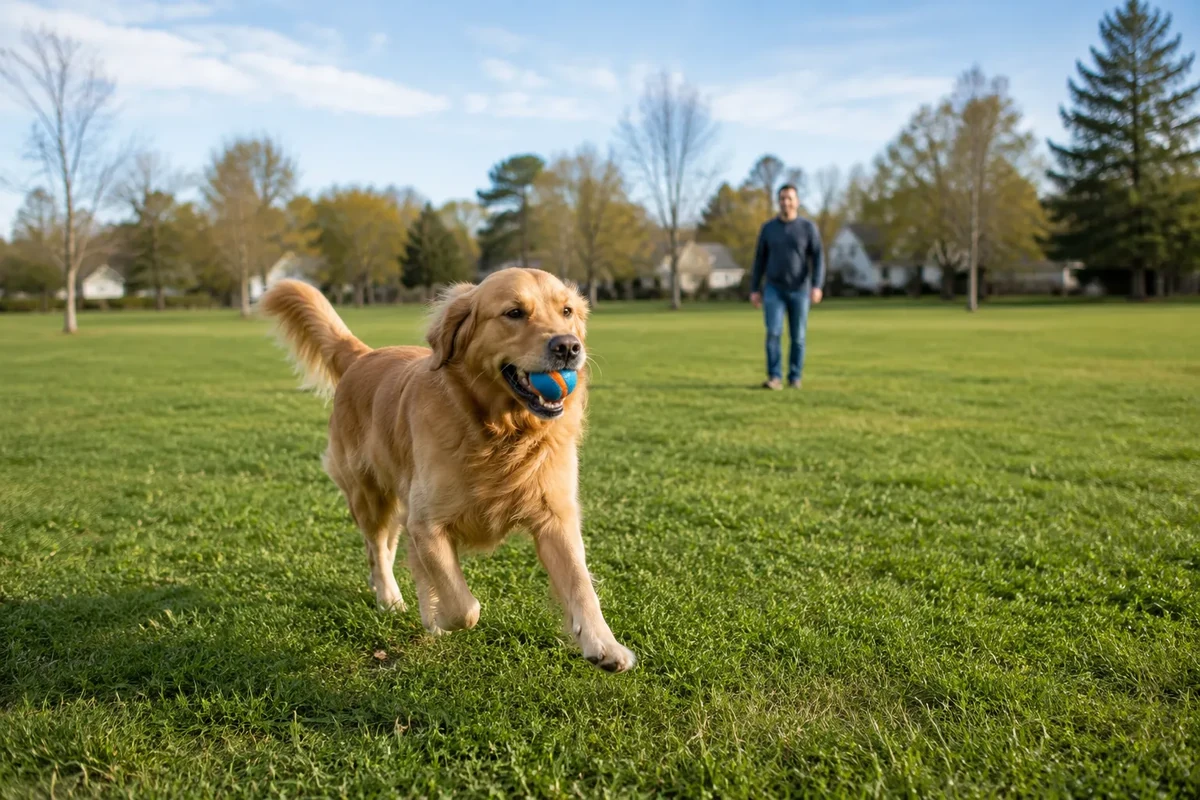
A lot of Goldens enjoy retrieving because retrieving is deeply connected to what the breed was developed to do.
That can make a ball, bumper or other appropriate retrieve an easy way to combine movement with interaction.
But you do not need to build the dog's entire life around throwing a tennis ball.
Walks, sniffing, swimming, training, hiking and other activities can all contribute.
In fact, variety is useful.
A dog that only knows how to become wildly excited every time a ball appears has not necessarily learned how to settle, think or move calmly through the rest of the day.
Exercise should make life better, not create a professional athlete who now demands another three hours of fetch.
A Yard Is Nice. It Is Not the Exercise Plan.
Goldens can certainly enjoy a fenced yard.
It is convenient for bathroom breaks, play and spending time outdoors with the family.
What a yard does not do is automatically make a dog active.
A Golden alone in a large backyard may simply sit at the door.
This is worth remembering for apartment owners too.
A Golden Retriever can live in an apartment if the owner is willing to provide enough activity outside it.
The practical difficulties are mostly about size, bathroom access, exercise and whether your building tolerates a large dog.
A house with a yard is easier.
It is not a substitute for involvement.
Yes, There Will Be Hair
If visible dog hair around the home bothers you, this is one of the biggest practical drawbacks of the breed.
Golden Retrievers have double coats.
They shed throughout the year, and there can be much heavier periods when the coat is changing.
You will probably find hair on hard floors, in carpet, on furniture, on dark clothing, along baseboards, under the couch, and in the car.
Somehow there will also be one strand stuck to a shirt that has never been in the same room as the dog.
Regular brushing helps.
It removes loose coat before part of it ends up elsewhere.
But there is no brushing technique that turns a Golden Retriever into a low-shedding breed.
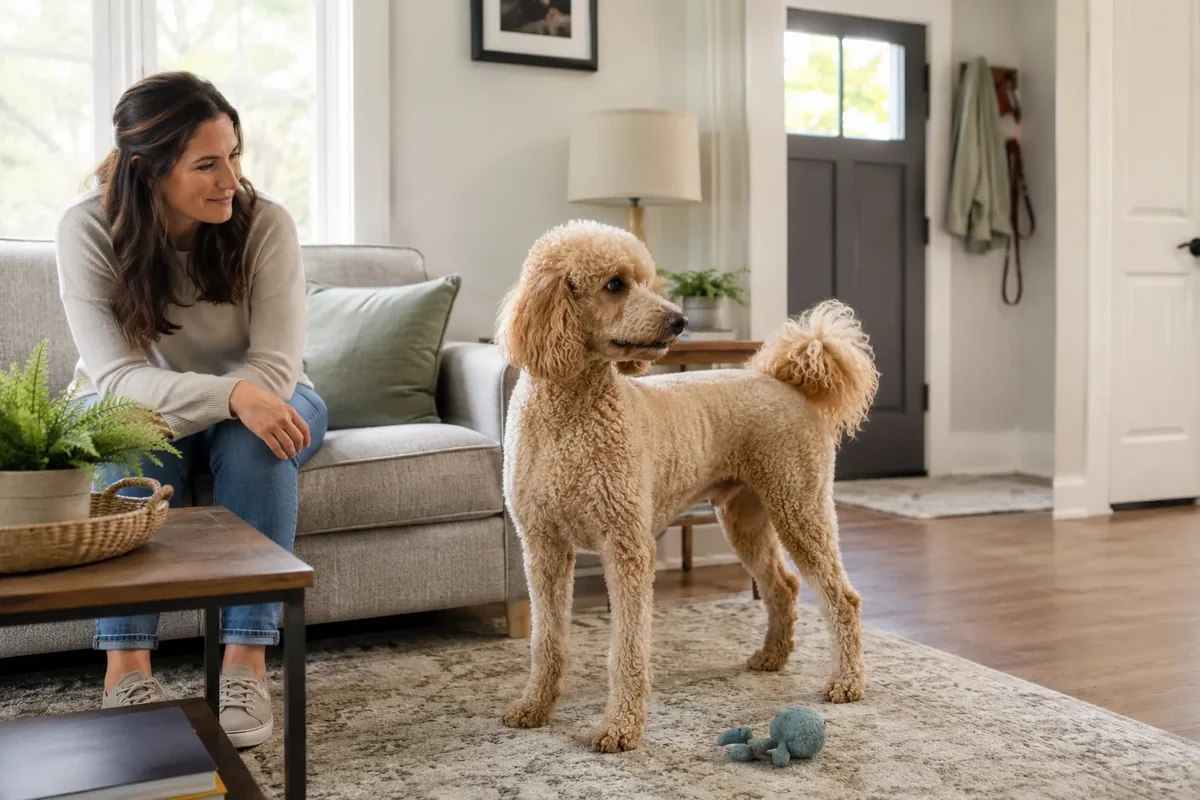
If you want the opposite coat tradeoff, our Poodle Pros and Cons guide covers a breed that typically leaves much less visible loose hair around the house but requires considerably more clipping and coat maintenance.

The Coat Needs Grooming, but Not Poodle-Level Grooming
Golden Retriever coat care is relatively straightforward.
You are not maintaining an elaborate haircut.
The coat normally stays natural.
But straightforward does not mean nonexistent.
The longer feathering around the legs, tail, chest and ears can tangle. Loose undercoat needs to come out. Mud, burrs and outdoor debris can get caught in the coat.
Regular brushing makes all of that easier to manage.
When shedding becomes heavier, coat maintenance usually needs more attention.
Basic care also includes nails, ears, teeth and bathing when appropriate.
One thing you should not treat as an easy shedding solution is shaving the whole dog.
A Golden Retriever's double coat is not something to remove simply because the vacuum cleaner is busy.
Grooming the Dog and Cleaning the House Are Two Separate Jobs
This is easy to underestimate.
You can brush a Golden regularly and still have dog hair on the floor.
You can clean the floor and still have loose coat ready to come off the dog.
Both jobs exist at the same time.
The upside is that household fur becomes predictable once you know where it tends to collect.
Carpet holds onto it.
Hard flooring lets it travel.
Room edges collect it.
Furniture creates hiding places underneath.
If you are already living with a heavy shedder, our Pet Hair Cleaning Guides cover those surfaces individually rather than pretending one cleaning method works everywhere.
Goldens Are Often Good With Children, but They're Still Big Dogs
The breed's generally friendly, social nature is one reason Golden Retrievers are so common in family homes.
A suitable individual can be a wonderful companion for children.
Still, “family dog” should never become shorthand for “no supervision required.”
A young Golden can be physically enthusiastic.
Running, jumping and turning around with a large tail can knock over a small child without any bad intent at all.
Children also need rules.
Dogs should not be climbed on, cornered, disturbed while eating or treated like stuffed animals.
The best family relationship comes from appropriate temperament, training and adults managing both the dog and the children.
Other Pets Often Work, but Don't Assume Anything
Many Goldens live very successfully with other dogs and cats.
Their generally social nature can help.
Early experience helps too.
But individual dogs still vary.
A puppy raised around a cat may behave differently from an adult dog seeing one for the first time.
Introductions should be managed instead of relying on breed reputation alone.
Friendly does not mean incapable of chasing something that runs.
They're Not the Obvious Choice for Guarding Your House
A Golden may bark when someone comes to the door.
Some will absolutely let you know that something unusual is happening outside.
But if the main reason you want a dog is serious property protection, this is not the breed's strongest job description.
Golden Retrievers are generally selected for a friendly, reliable temperament and willingness to work with people.
That is part of what makes them so popular.
You do not need to turn that into a flaw.
A dog can be an excellent companion without treating the UPS driver as an invading army.
They Can Be Good First Dogs
Golden Retrievers often make sense for first-time owners because training is generally approachable and the breed tends to be social and cooperative.
But there is an important qualifier.
Good first dog does not mean low-work first dog.
A new owner still has to deal with puppy training, house training, exercise, leash manners, grooming, shedding, veterinary care, a fairly large adult body, and adolescence.
The advantage is that many Goldens make the learning process rewarding.
They often want to work with you.
That gives a first-time owner some room to learn too.
Health Should Be Part of the Puppy Search
If you are buying a Golden Retriever puppy in the United States, do not choose a breeder based only on a nice website and a litter of cute puppies.
Ask about health clearances.
For Golden Retrievers, responsible breeding programs commonly screen breeding dogs for hips, elbows, eyes and heart.
Ask to see the actual results rather than accepting:
“Our dogs have never had any health problems.”
Those are not the same thing.
You can also ask about health and longevity in close relatives.
No breeder can guarantee that a puppy will never develop a medical problem.
Health screening is about improving the odds and avoiding breeding dogs with known issues that should have been evaluated first.
Don't Buy the Puppy Only Because the Parents Are Friendly
Temperament still matters.
Ideally, the breeder knows their dogs well enough to discuss what kind of puppies the pairing is likely to produce and to help match individuals to suitable homes.
One Golden may grow into a fairly relaxed family companion.
Another may have considerably more working drive and energy.
Neither is automatically better.
The question is whether the dog fits the household.
Someone wanting a hiking, training and retrieving partner may love a dog that another owner would find exhausting.
The Social Personality Can Make Alone Time Important to Teach
Because Goldens tend to enjoy being with people, owners sometimes accidentally create a dog that has almost never practiced being alone.
Then the first real separation becomes a major event.
A puppy should gradually learn that people leave and come back.
That the crate, pen or resting area is safe.
That quiet time is normal.
That every waking minute does not require somebody's full attention.
This is not about isolating the dog.
It is about giving a very social breed another useful life skill.
They Aren't Usually Difficult Dogs, but They Can Be Messy Dogs
There is an everyday side of Golden ownership that breed descriptions rarely capture.
Water tends to stay in that coat.
Mud likes feathering.
Wet ears are very good at transferring water to walls.
A dog that loves retrieving may carry things around the house.
A Golden that has just gone swimming looks considerably less like the clean dog in the breed photo.
For many owners, none of this matters.
But if your ideal pet is extremely tidy, dry, quiet, low-shedding and never touches your belongings, the Golden Retriever is starting to lose points.
The Costs Are Ordinary Large-Dog Costs
Goldens do not normally require the regular clipping expense of a Poodle.
They are still not particularly cheap dogs.
There is food for a 55- to 75-pound animal.
Veterinary costs.
Preventive medications.
Beds and crates large enough to fit the dog.
Training.
Boarding or pet care when you travel.
Grooming if you prefer to have someone else handle baths, nails or coat maintenance.
And, depending on the dog, occasional replacement of an object that really should not have been left within reach of an adolescent retriever.
The puppy price is only the beginning of the budget.
Who Usually Enjoys Living With a Golden Retriever?
A Golden often fits well in a home that wants a genuinely social dog.
Someone who enjoys walking, playing or training with the dog will probably appreciate the breed more than someone looking for a pet that requires very little involvement.
You should also be reasonably comfortable with a medium-to-large dog, dog hair, regular exercise, coat care, an enthusiastic puppy stage, and having a dog that likes being included in family life.
You do not need a huge property.
You do need time.
Who Should Think Twice?
A Golden Retriever may not be the best choice if loose hair around the house is a major problem for you.
Or if you need a very independent dog.
Or if daily exercise is unlikely to happen.
Or if you want a serious guard dog.
Or if the idea of managing an energetic 60-pound adolescent sounds miserable.
The breed's friendly reputation sometimes makes people overlook these practical issues.
A Golden can be easy to like and still be the wrong dog for a particular home.
Golden Retriever FAQ
Do Golden Retrievers shed a lot?
Yes. Goldens have double coats and normally shed throughout the year, with heavier periods when the coat changes seasonally. Regular brushing helps remove loose hair, but owners should still expect fur around the home.
Are Golden Retrievers easy to train?
They are generally considered very trainable and often enjoy working with people. That makes training pleasant, but it does not remove the need for consistency. Young Goldens still have to learn leash manners, recall, settling, appropriate chewing and other basic household skills.
Are Golden Retrievers good with children?
They often can be excellent family dogs. Their size and enthusiasm still matter, especially around small children, and interactions should be supervised. Children also need to learn how to behave respectfully around dogs.
Can a Golden Retriever live in an apartment?
Yes, provided the owner can consistently meet the dog's exercise, bathroom, training and social needs. Their size makes apartment living less convenient than with a small breed, but lack of a private yard does not automatically make it unsuitable.
How much exercise does a Golden Retriever need?
There is no single number that fits every dog. Healthy young adults are generally active and benefit from regular physical activity plus opportunities to use their brains. Age, health and individual energy level should guide the routine.
Are Golden Retrievers good for first-time owners?
They often can be. Their friendly temperament and trainability are helpful for a new owner. The owner still needs to be ready for a large dog, exercise, training, significant shedding and normal puppy and adolescent behavior.
Do Golden Retrievers need professional grooming?
Not necessarily. Their coat does not normally require regular clipping. Many owners manage brushing, bathing and basic coat care at home, while others use a groomer for convenience.
Are Golden Retrievers good guard dogs?
They may bark to alert you to someone outside, but the breed is generally known for being friendly and people-oriented. A Golden Retriever is not the obvious choice for someone specifically seeking a serious protection dog.
Is a Golden Retriever Right for You?
Golden Retrievers are popular for good reasons.
They tend to be social.
They are usually enjoyable to train.
They can fit into family life extremely well.
And if you want a dog that can go for a hike in the morning and lie near the family later, a Golden can make a lot of sense.
The less glamorous parts count too.
There is hair.
There is grooming.
There is a puppy stage that may involve much more energy than the adult dogs in photographs suggest.
There is a fairly large body that needs exercise and manners.
And there is a social dog that usually wants to be part of your life rather than simply live somewhere in the background.
None of those are hidden defects.
They are just part of the package.
If you want that package, a Golden Retriever can be a very easy dog to love.
If you mainly want the friendly reputation without the shedding, exercise, training and daily involvement attached to it, it is worth looking at other breeds before bringing one home.