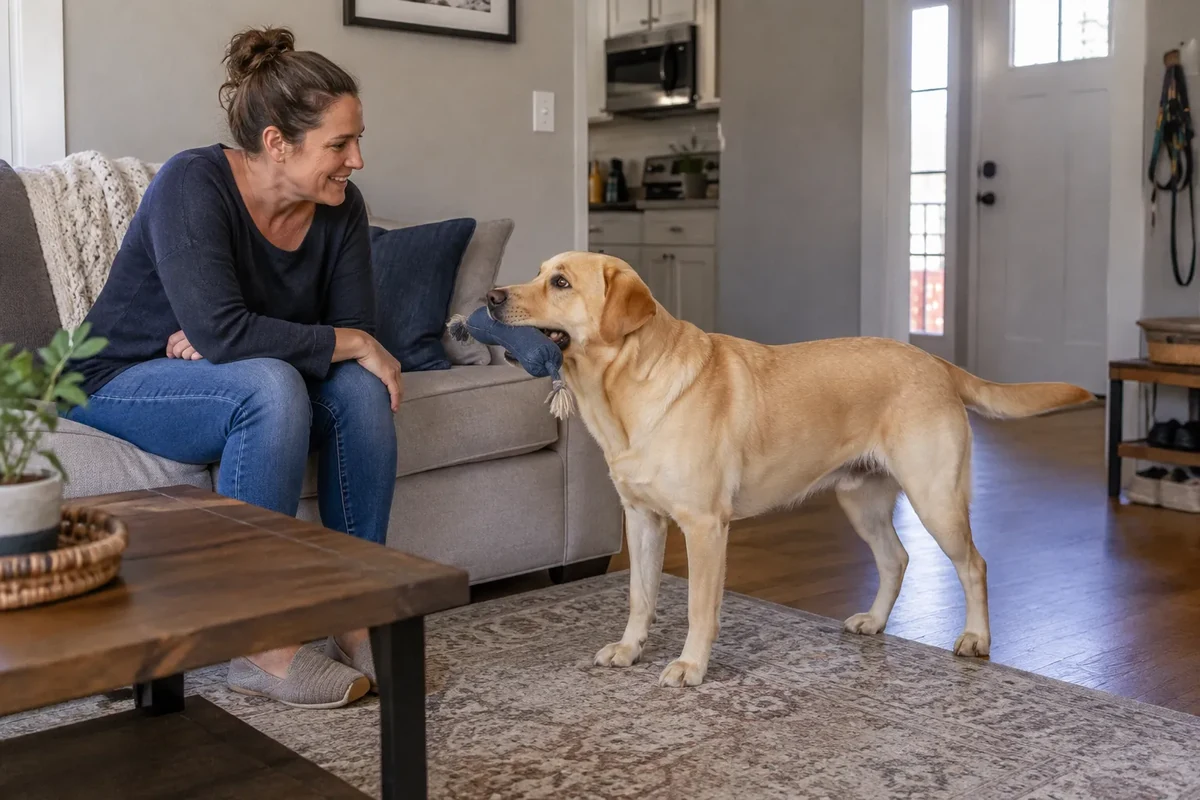
Labrador Retrievers have a way of looking uncomplicated.
Short coat. Friendly face. Tennis ball somewhere nearby.
They are often described as easygoing family dogs, and compared with some breeds, a well-adjusted adult Lab really can be refreshingly straightforward to live with.
But there is a fairly energetic road between “cute Labrador puppy” and “calm adult dog lying under the kitchen table.”
A Lab grows into a strong 55- to 80-pound retriever. Young ones can be busy, physical, mouthy and extremely interested in food. The short coat sheds much more than many first-time owners expect. Exercise cannot be replaced with access to a backyard, and being friendly does not automatically teach a dog how to walk politely on a leash.
None of that makes Labradors difficult dogs.
It just means the easy reputation needs some context.
First, This Is a Fairly Big Dog
Adult Labradors are generally about 21.5 to 24.5 inches at the shoulder and roughly 55 to 80 pounds.
A healthy Lab should look sturdy and athletic rather than heavy.
That size is worth thinking about before bringing home a puppy that currently fits comfortably in your lap.
An adult Lab can pull hard.
It can knock into a small child without meaning to.
A crate takes up real floor space.
So does the dog bed.
Food disappears faster than it would with a 15-pound companion dog.
And if the dog decides the passenger seat is the correct place to sit, you will quickly understand why Labrador size matters.
Life expectancy is generally around 11 to 13 years, so this is not a short-term commitment to the adorable puppy stage.
You are choosing the adult dog too.
Being Friendly Makes Many Things Easier
A typical Labrador is not known for approaching normal life with great suspicion.
Many are social with people and comfortable participating in a busy household.
That can make everyday life pleasant.
Visitors do not necessarily require a complicated management plan.
Going somewhere with the dog can be enjoyable.
Training classes often suit them.
Many Labs seem genuinely pleased that people exist.
For families who want an involved dog rather than one that prefers to keep its distance, that temperament can be a major advantage.
But friendly dogs still need socialization.
They still need to learn how to behave around strangers, dogs, children, traffic and unfamiliar places.
A dog rushing toward every person it sees because it desperately wants to say hello is not aggressive.
It is also not especially convenient.
A Labrador Can Be Very Trainable Without Being Automatically Well Behaved
Labs generally learn well.
Food helps.
Play helps.
Retrieving can help.
Simply enjoying interaction with people helps.
This is one reason Labradors appear in so many working roles in addition to ordinary family homes. They tend to respond well when a person gives them a clear job and makes learning worthwhile.
That is the good part.
The less convenient part is that an untrained friendly Lab is still a large dog.
A happy 70-pound animal dragging you toward another dog is a leash problem.
A Labrador launching both front paws onto a visitor is a manners problem.
Stealing something from the counter and running away with it is still annoying even if the dog looks delighted about the whole arrangement.
Training pays off quickly with this breed because so much everyday behavior becomes easier once the basics are in place.
The Puppy Stage Deserves More Attention Than It Gets
People tend to talk about adult Labradors.
The dog sleeping beside the family.
The dog swimming at the lake.
The dog gently carrying a toy.
Then a puppy arrives and attempts to put the entire house in its mouth.
Young Labs are retrievers, and many are enthusiastic about carrying, chewing and investigating objects.
Shoes can be interesting.
Socks can be interesting.
A cardboard box can apparently be the most interesting object ever manufactured.
This is where puppy-proofing matters.
Do not rely on repeatedly catching the puppy doing the wrong thing.
Make the wrong things harder to access.
Provide appropriate things to chew and carry.
Teach leave it.
Teach drop it.
Teach the puppy that giving something up does not always mean the fun ends forever.
And be careful about turning stolen-object retrieval into a daily game of chase. If running away with a sock reliably produces five minutes of human entertainment, the dog may decide the system is working perfectly.
Food Motivation Is Useful
Training a dog that likes food can be wonderfully convenient.
A small reward can make a new behavior very easy to explain.
Recall practice gets more interesting.
Loose-leash walking becomes worth paying attention to.
Handling exercises become less strange.
A food-motivated Lab often gives you a lot to work with.
The problem is that training treats still contain calories.
So do pieces from the kitchen.
So do the extra snacks handed out because the dog has perfected a facial expression suggesting it has not eaten since Tuesday.
Portions can creep upward surprisingly easily.
That matters because Labradors are large, active dogs whose joints still have to carry whatever weight ends up on the frame.
You do not need to obsess over a number on the scale.
You do need to pay attention to body condition and adjust food when necessary.
If you are unsure whether your Lab is at an appropriate weight, that is a straightforward conversation to have with your veterinarian.
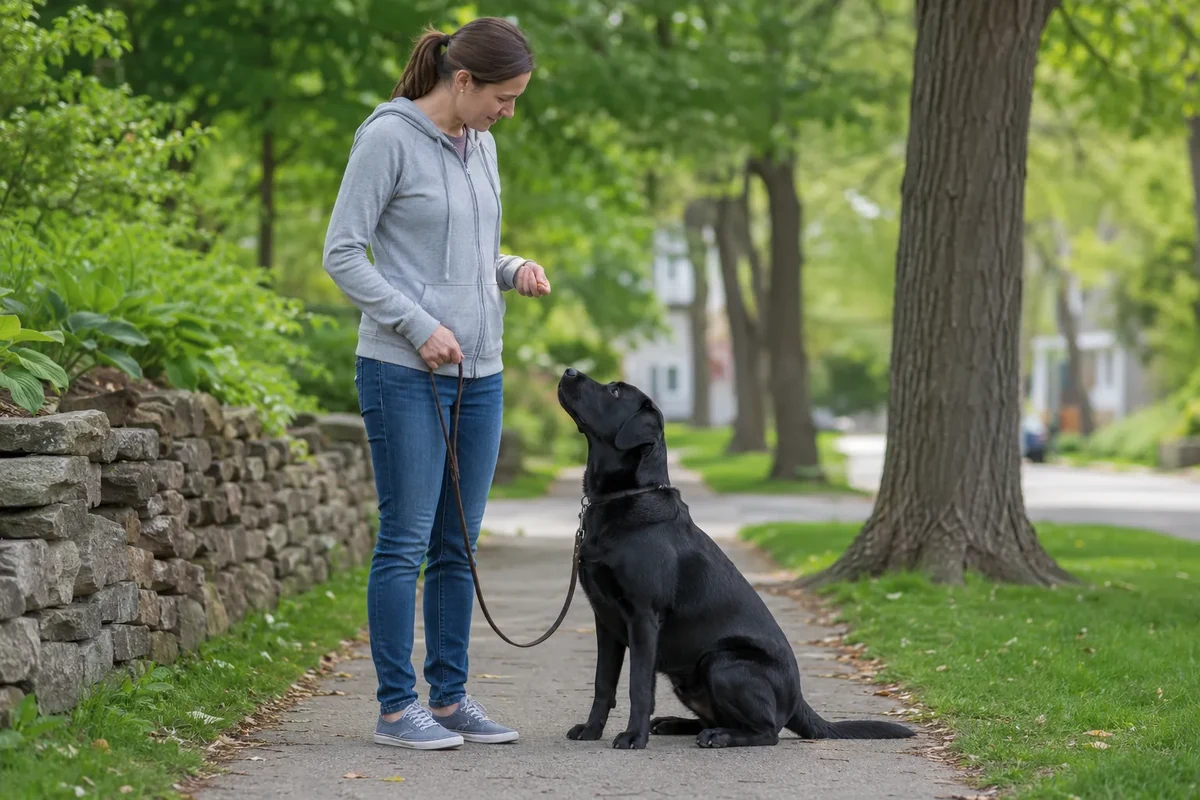
Their Appetite Is Not a Substitute for Exercise
A bored Lab with a full food bowl is still bored.
Healthy adult Labradors are active sporting dogs.
Many enjoy long walks, retrieving, swimming, hiking, training and outdoor time.
You do not have to choose one official Labrador activity.
The important part is that the dog gets regular opportunities to move and interact with the world.
A walk can be exercise.
A walk where the dog also gets time to sniff and explore gives the brain something to do.
A few short training exercises make the same outing more useful.
Retrieving gives you interaction and movement together.
There is no universal number of minutes that every Labrador needs.
A young healthy adult and an older dog with joint problems should not be on the same routine.
But a Lab is generally a poor match for someone who wants a dog that needs little more than bathroom breaks.
Puppies Don't Need an Adult Athlete's Workout
This is important because young Labradors can look as though they have unlimited energy.
That does not mean the answer is simply more and more hard exercise.
A growing puppy is still developing physically.
Training, exploration, age-appropriate play and short outings all count as useful activity.
You do not need to exhaust a puppy into behaving.
In fact, overtired puppies can be remarkably bad at demonstrating how tired they actually are.
If you are planning running, long hikes or another demanding activity with a growing dog, ask your veterinarian when that particular dog is physically ready for it.
A Backyard Is Convenient, Not Magical
Labs often love having outdoor space.
A fenced yard makes bathroom breaks easier.
There is room to play.
You can practice training without leaving home.
What the yard cannot do is provide meaningful activity by itself.
A Lab may wander around for a few minutes and then come back to the door because the interesting thing was never the grass.
It was doing something with you.
This is why apartment living is not automatically impossible either.
A Labrador in an apartment needs more deliberate planning for bathroom breaks, walks and activity, and the dog's size is less convenient in a small space.
But a large yard does not rescue a lifestyle where the dog receives almost no attention.
Swimming Is Common. It Is Not a Requirement.
Many Labradors love water.
The breed's history makes that unsurprising, and a dog that enjoys swimming can get a lot out of it.
But not every Lab arrives knowing what to do in deep water.
A puppy should have safe, gradual experiences rather than being thrown in and expected to figure it out.
Older dogs, dogs with health problems and poor swimmers need different considerations too.
And if your Labrador thinks every muddy pond is a private resort, remember that swimming has an aftercare phase.
Wet Labrador is a condition that spreads rapidly through cars, towels and hallways.
Owning a lake is not required.
Owning a few towels is useful.
The Short Coat Is Deceptive
This is one of the biggest surprises for new Lab owners.
The coat looks simple.
It is short.
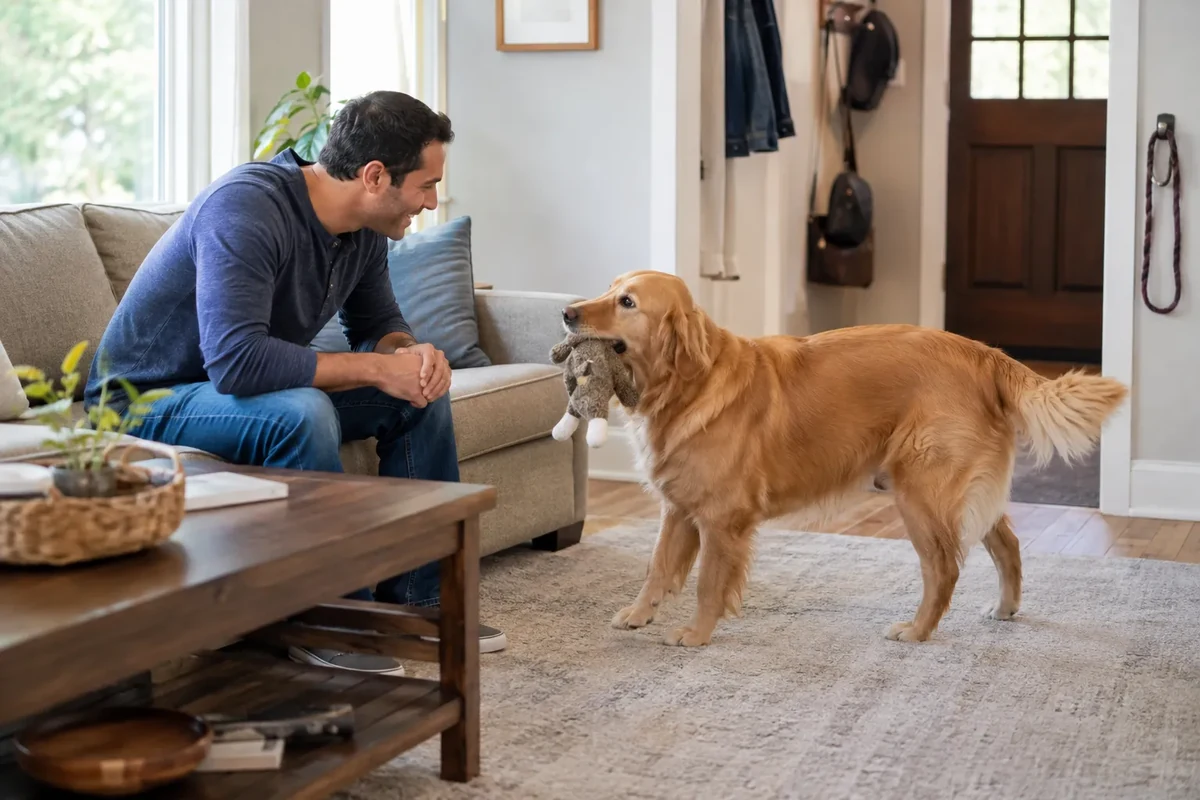
There is no long feathering to untangle like a Golden Retriever.
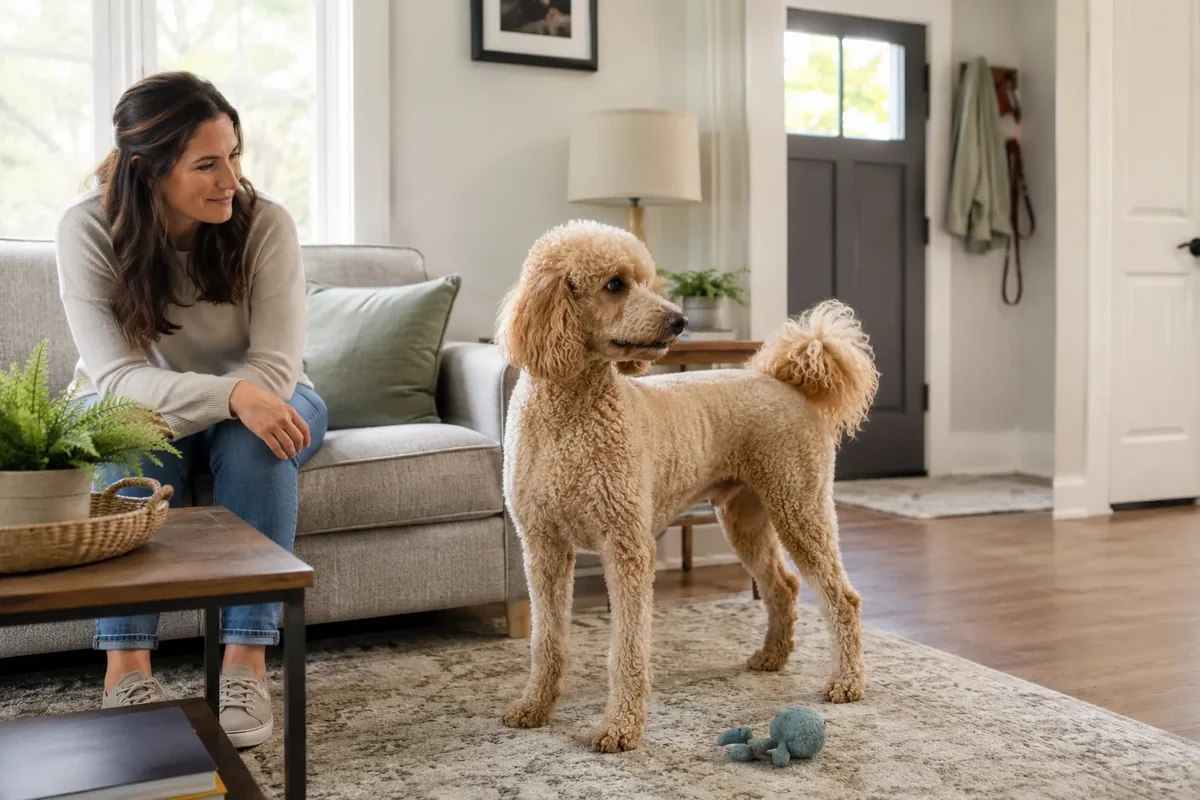
There is no curly coat to clip like a Poodle.
And yet a Labrador can leave an impressive amount of hair around a house.
Labs have a dense double coat.
Loose hairs are short enough to work their way into upholstery, carpet, clothing and car interiors without looking especially dramatic while still attached to the dog.
The result is not usually long golden tumbleweeds.
It is lots of small Labrador hairs appearing everywhere.
Yes, Labs Shed Quite a Bit
If you strongly dislike loose hair in the home, count this as a genuine con.
There can be shedding throughout the year, with more noticeable periods when the coat is changing.
Expect some combination of hair on floors, carpet, sofas, clothing, dog beds, the car, room edges, and under furniture.
Regular brushing helps remove coat that is already loose.
It does not make the breed non-shedding.
If you want a dog with a much lower level of visible loose hair in the home, compare that tradeoff with our Poodle Pros and Cons guide. A Poodle usually gives you much less household shedding, but considerably more work goes into maintaining the coat itself.
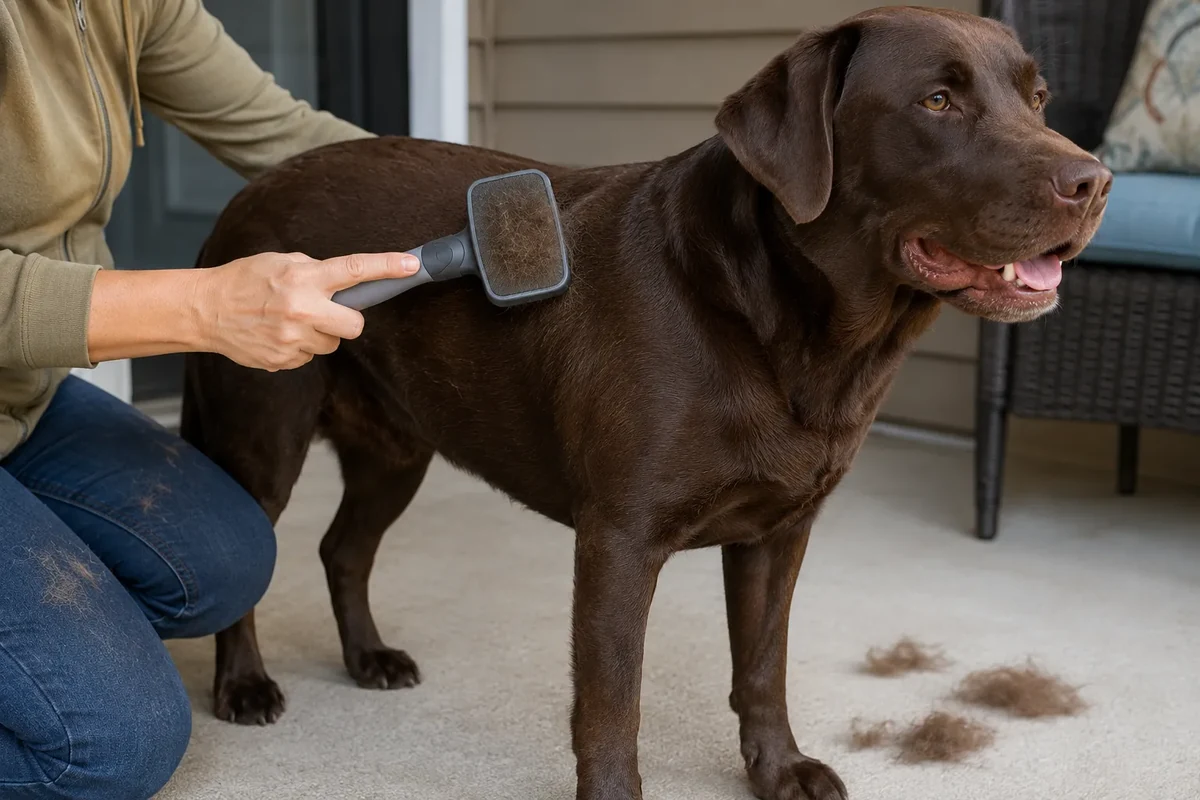
Labrador Grooming Is Pretty Simple
The good news is that the coat does not need elaborate maintenance.
A normal Labrador does not need regular haircuts.
There is no long feathering to shape.
There is no reason to invent complicated grooming rituals for a healthy coat.
Regular brushing is useful, particularly when shedding picks up.
Baths are needed when the dog actually needs a bath.
Nails, ears, teeth and skin still need routine attention.
That is about the level of complexity most owners are dealing with.
Simple coat care and low shedding are not the same thing, though.
You may spend less time untangling coat than a Golden Retriever owner and more time finding tiny hairs attached to the sofa.
Grooming the Dog Doesn't End the House-Cleaning Job
This is true of every heavy shedder.
Brushing catches some loose coat before it lands around the home.
Some of it still lands around the home.
And short Lab hair can be surprisingly persistent once it works into carpet or fabric.
Where it ends up depends on the house.
Hard floors allow hair to move until it reaches an edge or furniture.
Carpet holds onto it.
Upholstery can catch it.
Car interiors seem to keep it as a permanent souvenir.
Our Pet Hair Cleaning Guides cover those surfaces separately, because there is no single technique that works equally well on every part of the house.
A Labrador Tail Takes Up Space Too
The traditional Labrador tail is thick and strong.
On a happy dog, it can also be very active.
This is not exactly a serious breed drawback.
It does become noticeable around low coffee tables, drinks placed at dog height and narrow spaces.
Mostly it is one more reminder that a cheerful adult Labrador is a substantial animal, not a small dog with a large personality.
You learn where to put the glass.
Family Life Is One of the Breed's Strongest Areas
Labradors often fit naturally into active family households.
They tend to enjoy company.
They can be playful without requiring every interaction to be formal training.
And their general willingness to participate makes it easier to include the dog in ordinary life.
That still does not make every Labrador automatically perfect with children.
A young Lab can be very physical.
Small children can be knocked over.
A child grabbing at food, climbing on the dog or interfering with rest can make any dog uncomfortable.
Normal supervision still applies.
The good family reputation is useful information.
It is not permission to stop paying attention.
Other Pets Can Work Fine
Many Labs live with other dogs.
Many live with cats.
The breed's generally social temperament can make introductions easier than they might be with some dogs.
But individual behavior still matters.
A young Labrador may desperately want to play with an older dog that would prefer to be left alone.
A cat running across the room can trigger chasing even in a dog that is generally friendly.
Use introductions and management instead of assuming that “Labrador” means instant friendship with every animal.
Labs Often Love People a Little Too Efficiently
A friendly dog can create its own training problem.
If your Labrador believes every stranger exists specifically to provide attention, passing people calmly can take practice.
The same applies to guests.
The dog needs to learn that a visitor entering the house does not always require a full-body celebration.
Teaching calm greetings while the dog is young is easier than trying to explain the concept after 75 pounds of Labrador has developed a reliable launching technique.
Friendliness is the trait you want.
Impulse control is how you make that friendliness pleasant to live with.
Don't Choose a Labrador for Serious Guard Work
A Lab may bark when somebody comes to the door.
It may notice something unfamiliar outside.
That does not make the breed an obvious choice for someone looking specifically for a strong guarding instinct.
Labradors are generally selected for social, cooperative behavior.
For most households, that is a positive.
If your main reason for getting a dog is intimidation or protection, other breed traits probably deserve more attention than how friendly the puppy looks.
Health Screening Matters Before You Bring the Puppy Home
If you are buying a Labrador puppy, health testing should be part of the breeder conversation.
Do not stop at:
“The parents have never been sick.”
That does not tell you whether appropriate screening was done.
Responsible Labrador breeding programs use breed-specific evaluations intended to reduce the risk of passing on known inherited problems.
Hips and elbows are important.
Eye testing is part of responsible screening.
There are also inherited conditions for which DNA testing may be recommended.
You do not need to become a veterinary geneticist before buying a dog.
You do need to ask for the actual results and know that “healthy-looking” and “health-tested” are not interchangeable.
Ask What Kind of Labradors the Breeder Produces
Not every Labrador is identical in energy, drive or working style.
Some breeding lines are selected heavily around field work and performance.
Others are more commonly bred toward conformation or companion homes.
There can be plenty of overlap, but the differences matter.
A person looking for an intensely driven retriever to train every weekend may want something very different from a family that hopes for an active but manageable companion.
A good breeder should be able to talk about the temperament and energy of the parents without simply saying:
“Labs are great family dogs.”
You are not buying the breed description.
You are bringing home one individual dog.
The Weight Question Deserves Ongoing Attention
Labradors often make it easy to feed too much because many are highly interested in food.
That interest is incredibly useful for training.
It also means portions deserve attention.
You should be able to reward the dog without losing track of how much food is being added during the day.
If a significant amount of the daily ration is being used for training, it can often be taken from the dog's regular food rather than automatically added on top.
Body condition matters more than trying to force every Labrador into one exact number on the scale.
Two healthy Labs can differ substantially in size.
If weight begins creeping upward or you are unsure what condition is appropriate, talk with your veterinarian before solving it with internet diet formulas.
First-Time Owners Often Do Well With Labs
There are good reasons Labradors are frequently recommended to people getting their first dog.
They are generally trainable.
They often like people.
Motivating them is usually not difficult.
Their coat care is straightforward.
And they can adapt to a lot of normal family activities.
But this is still a first dog that may eventually weigh 70 pounds and have enough energy to make bad leash habits memorable.
New owners should be prepared to learn about house training, socialization, leash manners, recall, appropriate chewing, exercise, grooming, body condition, and veterinary care.
The breed can make those lessons pleasant.
It does not make them optional.
Labs Can Be Excellent Outdoor Companions
If you want a dog that can be involved in active weekends, Labradors have a lot going for them.
Many enjoy hiking.
Many enjoy water.
Retrieving is an obvious option.
Training games travel easily.
They can participate in a wide range of dog sports and activities.
The trick is not to turn “active breed” into “dog must be physically exhausted every day.”
An adult Labrador should also learn how to settle.
A dog that can run for miles but has never learned to relax in the house is not necessarily easier to live with.
Physical activity and household calm are separate skills.
Teach both.
They're Less Complicated Than Some Breeds, Not Maintenance-Free
This is probably the simplest way to describe Labrador ownership.
You do not have the coat maintenance of a Poodle.
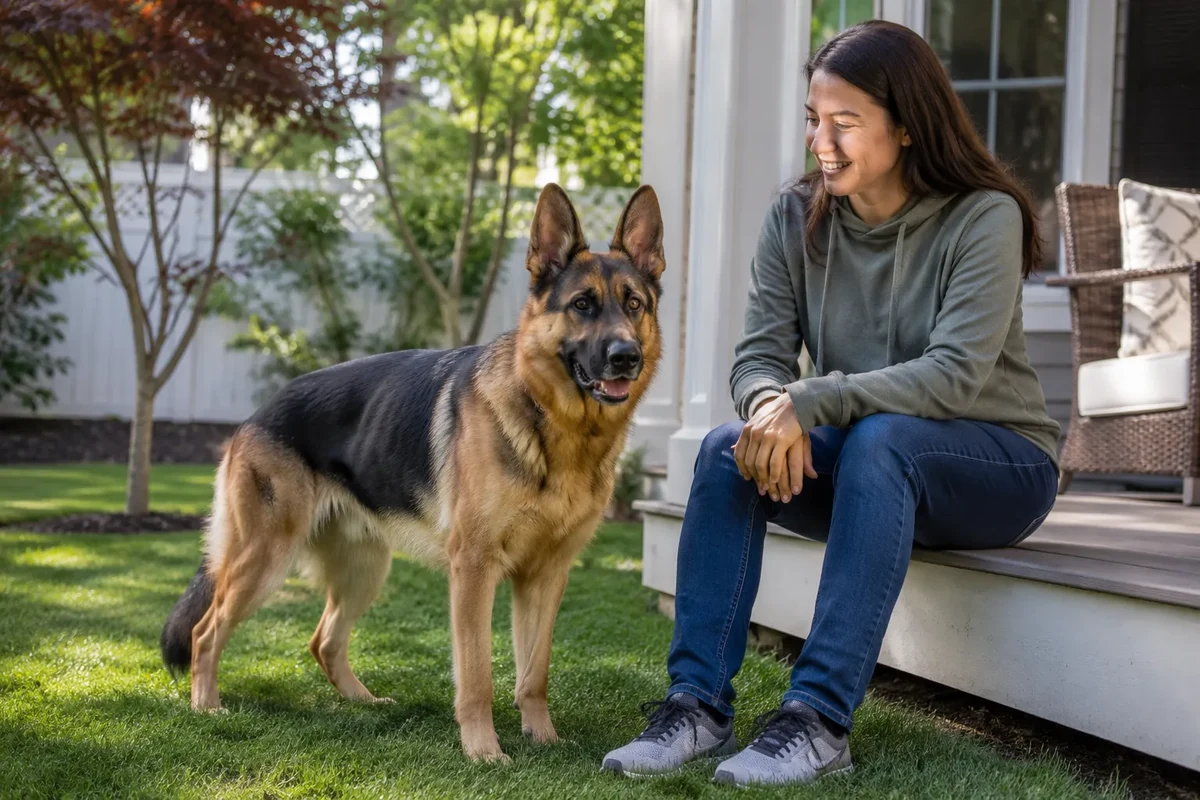
You do not have the natural reserve toward strangers that can be more pronounced in a German Shepherd.
You do not have long Golden Retriever feathering to untangle.
But you still have a large dog, regular exercise, training, a lot of shedding, food management, a puppy that may enthusiastically chew things, and a very social animal that wants involvement.
The maintenance is ordinary dog work.
There is just a decent amount of it.
Who Usually Enjoys Living With a Labrador?
A Lab often works well for someone who wants a friendly, active companion and is comfortable doing things with the dog.
You do not need to hunt.
You do not need a swimming pool.
You do not need to spend every weekend competing in dog sports.
You should be reasonably comfortable with exercise, training and a dog that may take an enthusiastic interest in food, toys and whatever the household is doing.
It also helps enormously if loose dog hair does not cause an existential crisis.
Who Should Think Twice?
A Labrador may not be a great match if you want very little shedding.
Or a tiny dog.
Or a dog that needs minimal exercise.
Or a very independent pet that is content with little daily interaction.
Think twice if walking a strong medium-to-large dog would be physically difficult.
And think especially carefully if your entire plan for puppy behavior is:
“Labs are naturally good dogs.”
A good Labrador temperament gives you excellent material to work with.
You still have to do the work.
Labrador Retriever FAQ
Do Labrador Retrievers shed a lot?
Yes. Labradors have short double coats and can shed substantially throughout the year, with heavier periods when the coat changes. Their hair is shorter than a Golden Retriever's, but that does not mean there is less of it around the house.
Are Labradors easy to train?
They are generally very trainable and often highly motivated by food, play and interaction. Young Labs still need consistent work on leash manners, recall, jumping, chewing and settling.
Are Labradors good with children?
They often can be excellent family dogs. Young Labs can be physically enthusiastic, so supervision and training still matter, especially around small children.
Can a Labrador live in an apartment?
Yes, but their size and activity level make it less convenient than living with a smaller dog. Regular walks, bathroom breaks, training and mental activity still need to happen outside the apartment.
How much exercise does a Labrador need?
There is no single amount that fits every Lab. Healthy adults are generally active dogs and benefit from regular physical exercise plus training, sniffing, retrieving or other mental activity. Age, health and individual energy level should guide the routine.
Do all Labradors love swimming?
No. Many Labs enjoy water, but individual dogs vary. Puppies and inexperienced dogs should be introduced to water gradually and safely rather than assumed to be natural swimmers.
Are Labradors good for first-time owners?
They often can be. Their social temperament and trainability are helpful for new owners, but the owner still needs to be ready for a strong adult dog, exercise, shedding, training and an energetic puppy stage.
Do Labradors need professional grooming?
Usually not for routine haircuts. Their short double coat is fairly straightforward to maintain with regular brushing and ordinary coat care. Some owners still use professional groomers for bathing, nails or convenience.
Are Labradors good guard dogs?
They may alert to unusual activity, but Labradors are generally known for being friendly and socially cooperative rather than strongly territorial. They are not an obvious breed to choose specifically for serious protection.
Is a Labrador Retriever Right for You?
Labradors are popular because a lot of their good qualities are genuinely useful in everyday life.
They are usually enjoyable to train.
They tend to like people.
They can participate in an active household without requiring you to build your entire identity around dog ownership.
Their coat is simple to maintain.
And many grow into the kind of adult dog that fits naturally into family routines.
The parts people underestimate are mostly practical.
A young Lab can be a lot of puppy.
The adult dog is strong.
The appetite deserves management.
The short coat sheds far more than its appearance suggests.
And regular exercise and training do not disappear just because the breed has an easygoing reputation.
For someone who wants a social, active, trainable dog and does not mind hair around the house, those are very reasonable tradeoffs.
For someone whose ideal dog is small, quiet, low-shedding and almost entirely self-entertaining, they probably are not.
The Labrador's biggest advantage may be that there is not much mystery to the deal.
You get a friendly retriever that generally wants food, activity and people.
You just need to be sure you actually want all three.