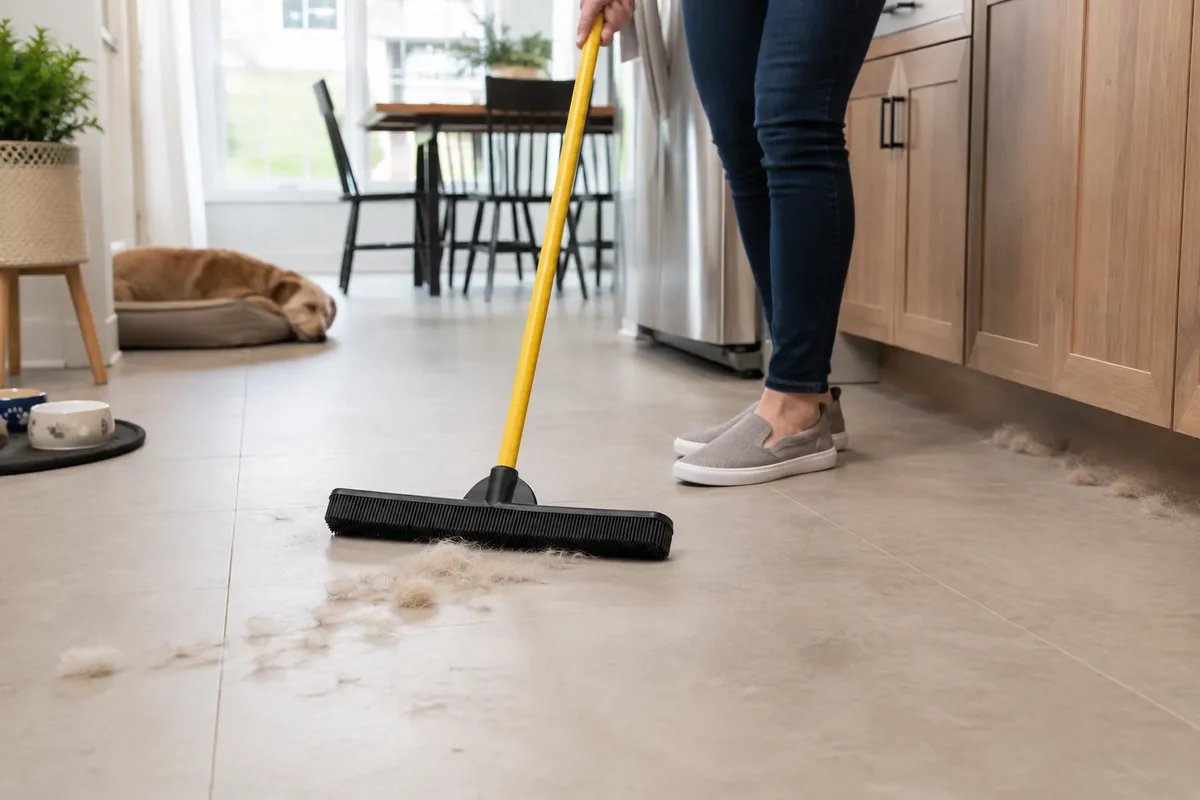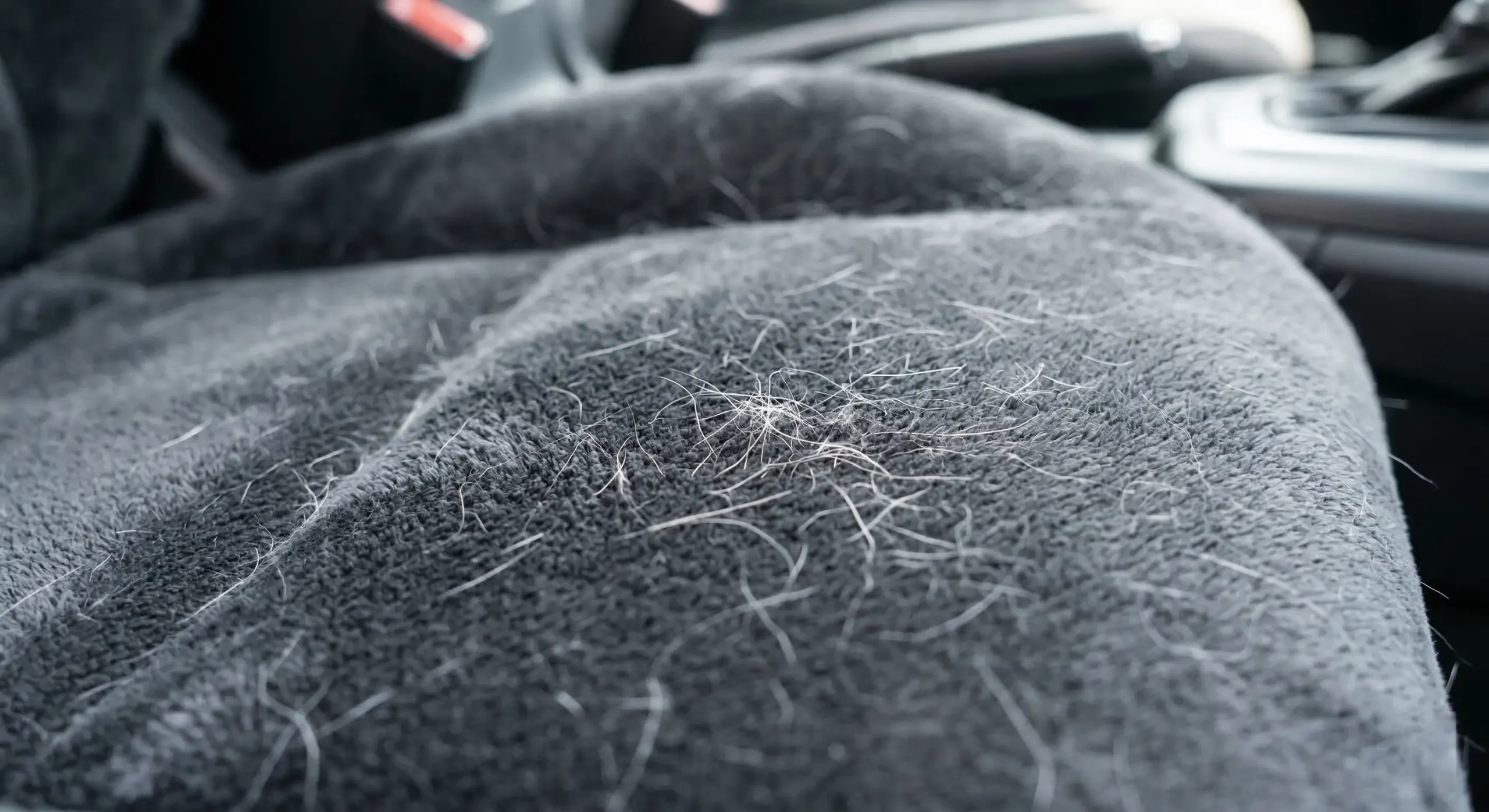
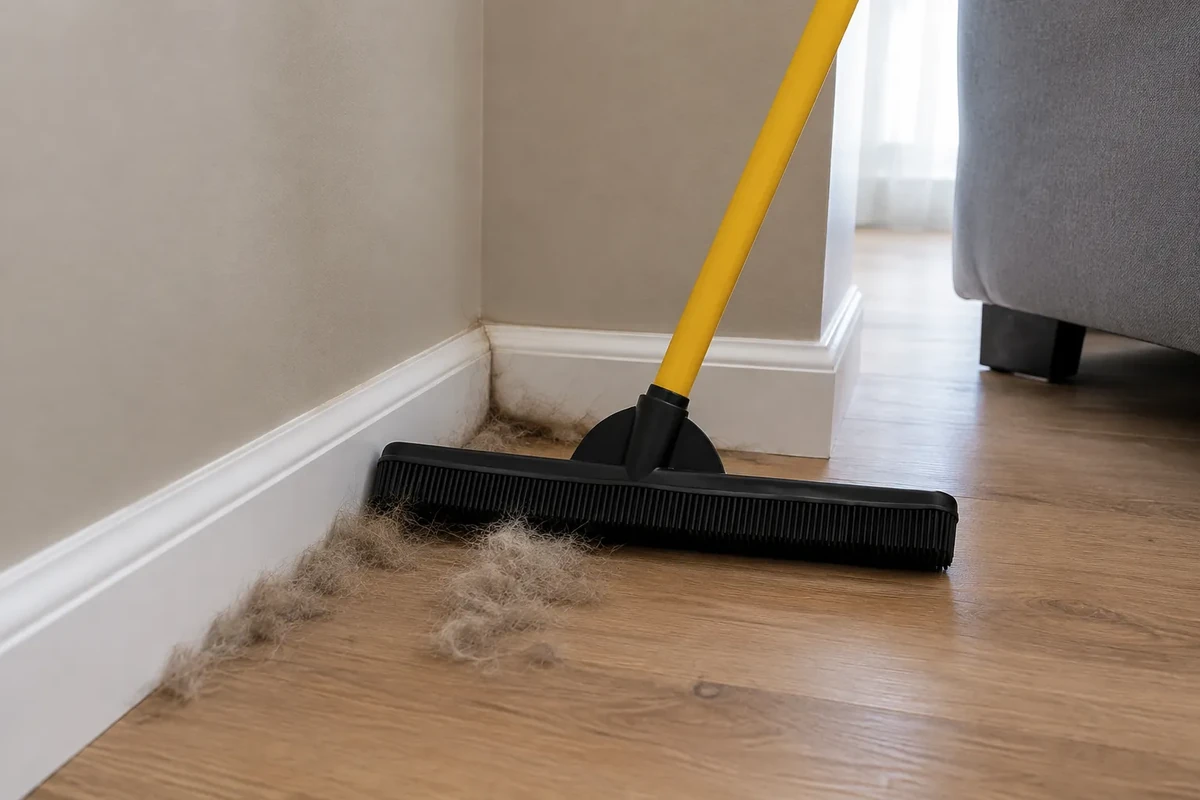
You can vacuum an entire room, put everything away, and still find a gray little fur border running along the baseboard.
Then you move the couch.
Different story.
Pet hair has a way of leaving the obvious parts of the floor and collecting exactly where regular cleaning tools spend the least amount of time: against walls, behind furniture legs, underneath beds, and in corners that look perfectly fine until the light hits them.
The middle of the room usually isn't the problem.
It's the edges.
Start With the Places You Normally Skip
Before cleaning the whole floor again, walk around the room and look at the perimeter.
Check behind doors. Look under the front edge of the couch. Shine a little light beneath the bed if you cannot see clearly. Run your eyes along the baseboards instead of looking at the center of the floor.
In a home with pets, you will usually find a pattern pretty quickly.
Hair tends to collect around:
- baseboards;
- furniture legs;
- under sofas and beds;
- behind nightstands;
- corners beside pet beds;
- floor vents;
- the space underneath radiators or low cabinets;
- the edges of area rugs.
Some of it gets pushed there by normal foot traffic. Some travels with air moving through the room. And some simply comes off the dog or cat in the exact spot where they spend most of the day.
There is no reason to clean all of those places with the same tool.
Baseboards Are Mostly an Edge Problem
The narrow strip where the floor meets the wall is easy to miss with a normal vacuum head.
Even when the center of the room is clean, a line of fur can stay tucked right against the baseboard.
A crevice attachment is usually the easiest place to start.
Move slowly enough to actually pick up the hair instead of making a quick lap around the room. Pay extra attention to corners, where several little collections of fur often end up meeting.
On a hard floor, a microfiber cloth or dust mop can also work well for light loose hair along the edge.
If there is a stubborn patch sitting just out from the wall, a small rubber brush can help gather it before you vacuum or pick it up.
You do not need to scrub the baseboard itself with whatever tool you are using on the floor. Painted trim can scuff, and there is little benefit in turning a pet-hair job into a paint-touch-up job.
Corners Are Where Loose Hair Goes to Retire
Room corners can collect an impressive amount of fur without looking particularly dirty from a few feet away.
A large broom head does not fit properly.
A vacuum head gets close but not always all the way in.
And because nobody walks directly through the corner, the hair stays there.
Use the smallest practical tool for the last few inches.
That might be a vacuum crevice attachment. It might be a handheld rubber brush. On a smooth hard floor, even a dry microfiber cloth can be enough.
The important part is getting into the corner instead of repeatedly pushing hair toward it.
If you are using a full-size rubber broom elsewhere in the room, gather the loose hair away from the wall first. Then finish the tight edge separately.
Trying to force a wide broom head into a tiny corner usually accomplishes less than switching tools.
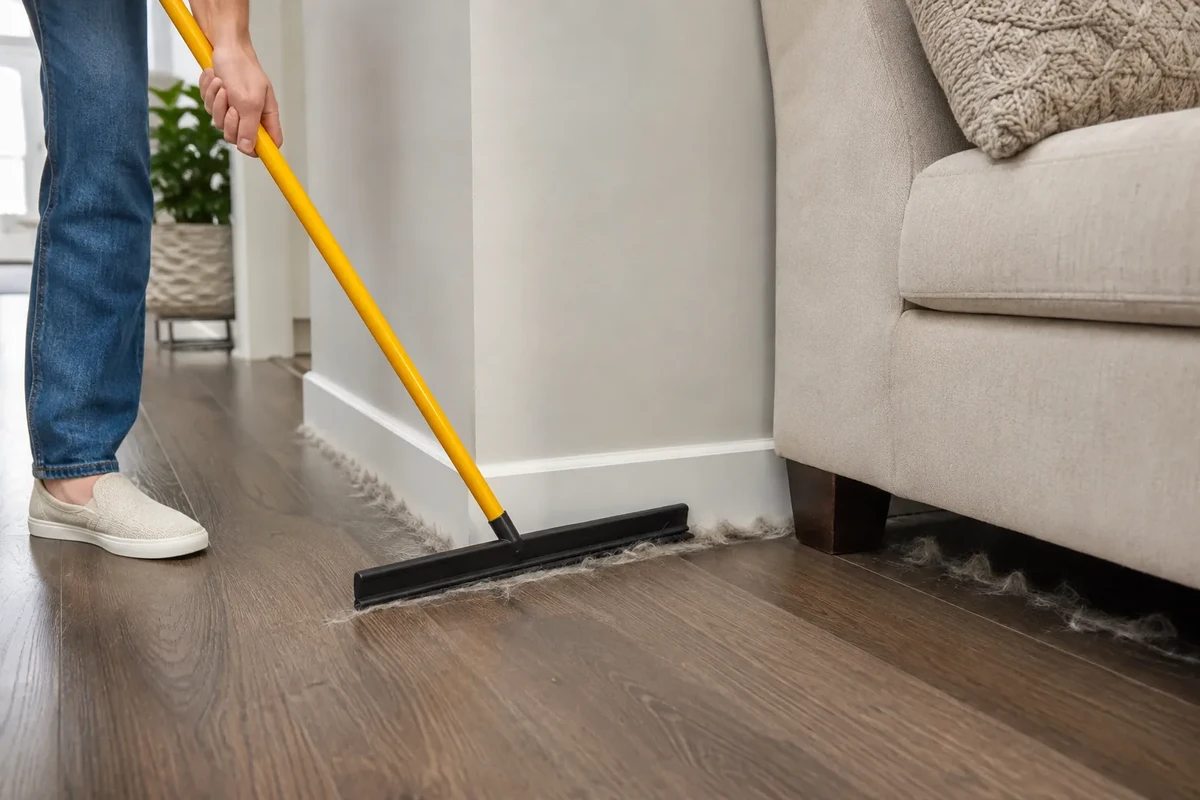
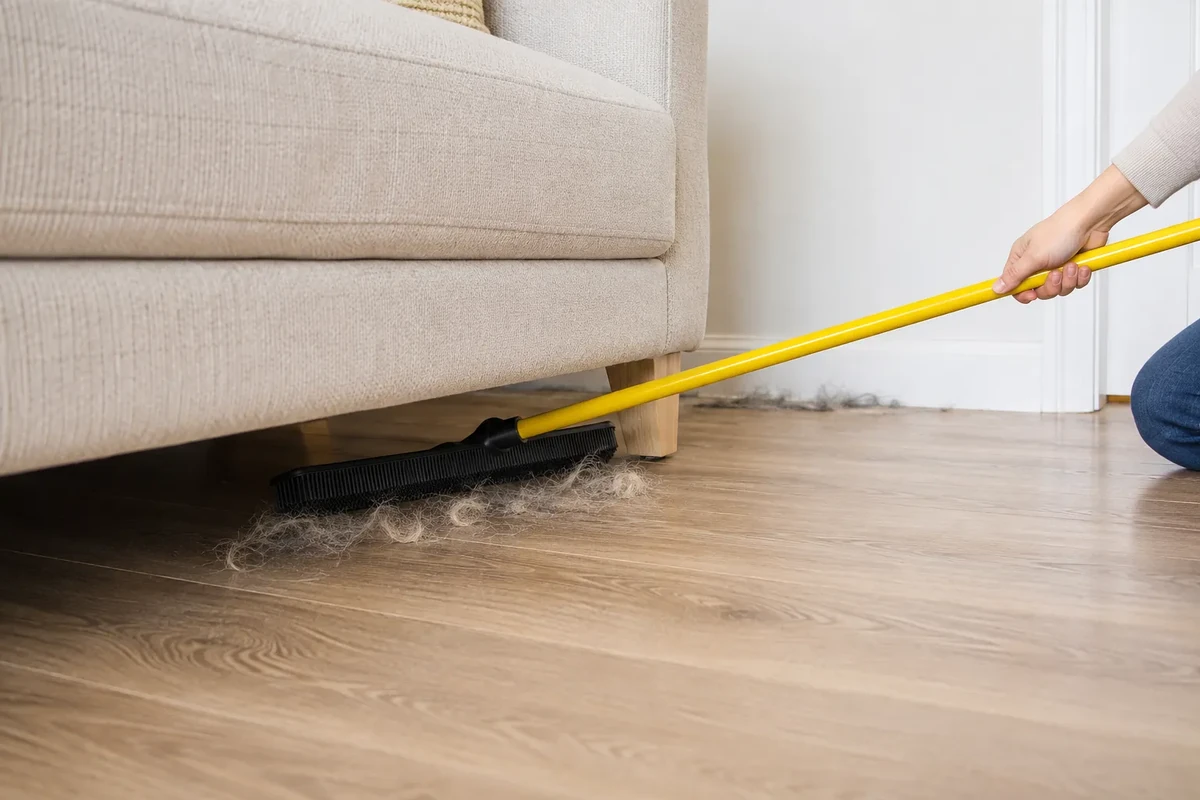
Under the Couch Is Usually Worse Than You Think
There are two kinds of under-sofa situations.
The first is the easy one: the couch sits high enough that a vacuum wand or low-profile mop slides underneath.
The second requires moving furniture.
If you can reach underneath safely without moving anything, start there. A vacuum extension or microfiber floor tool can collect the loose hair that has drifted out of sight.
If the gap is too low, do not blindly shove a rigid tool underneath and scrape it across the floor or furniture.
Move the couch only if it can be done safely and comfortably.
Once it is out of the way, you may discover that the floor underneath looks nothing like the rest of the room. Pet hair, dust, crumbs, and the occasional lost toy tend to accumulate together.
On hardwood or another smooth floor, collect the dry debris before doing any wet cleaning.
For finished wood specifically, the hardwood pet-hair guide covers the floor-care side in more detail.
Beds Have the Same Problem, Only Bigger
Under a bed is basically a large, low-traffic pet-hair storage area.
Especially if the cat goes underneath.
A long vacuum attachment or low-profile microfiber mop makes much more sense here than crawling around trying to collect individual clumps by hand.
Work from more than one side if possible. Hair sitting in the middle of a queen- or king-size bed may be surprisingly far from the nearest edge.
And look behind the headboard if there is space.
That narrow strip between furniture and wall is easy to forget for months at a time.
If a pet sleeps in the bedroom, it can collect considerably more hair than the open floor suggests.
Furniture Legs Create Tiny Hair Traps Everywhere
Dining tables and chairs are good examples.
You can clean the entire floor and still have strands wrapped around or sitting beside every chair leg.
The same thing happens around coffee tables, desks, plant stands, and narrow furniture feet.
Rather than trying to steer a large floor tool through every gap, clean the open area first.
Then come back for the legs.
A vacuum hose is useful when hair is mixed with crumbs. A small rubber tool can help when loose fur is sitting stubbornly around the base of the furniture.
If the furniture moves easily, shifting a chair a foot to the side is often faster than performing cleaning-tool gymnastics around all four legs.
Pet Beds Usually Explain the Mystery
If one corner of the room always seems furrier than everything else, look at what is sitting there.
A dog bed can shed almost as much loose hair back onto the floor as the dog.
So can a favorite blanket.
You clean around it, the pet lies down again, and a fresh ring of fur appears.
Move the bed during floor cleanup and check underneath it.
If the cover is removable and washable, deal with the hair on the bedding too. Otherwise, cleaning only the floor becomes a fairly short-lived victory.
The same applies to blankets on the couch.
If upholstery is the bigger problem, see How to Remove Pet Hair from Car Seats & Couches.
Be Careful Around Floor Vents
Floor and low wall vents are another place where loose hair collects.
The important word here is around.
Vacuum the accessible surface and surrounding floor with an appropriate attachment. If the vent cover can be cleaned according to your home's normal maintenance instructions, follow those rather than improvising.
There is no need to push cleaning tools deep into ductwork to chase pet hair you can barely see.
The goal of this job is ordinary household cleanup, not dismantling the HVAC system.
A Full-Size Rubber Broom Is Better for the Open Areas
A rubber broom can be useful for gathering pet hair from carpet or suitable hard floors, but it has the same limitation as any full-size floor tool: the head has a width.
That is useful in the middle of a room.
It is less useful behind a table leg or in the last inch of a corner.
For open flooring, one of the FURemover rubber brooms can help bring scattered hair together before pickup. For tight areas, switch to a hose attachment, microfiber tool, or smaller handheld brush.
There is no advantage in forcing one product to do every job.
The house is full of different shapes. Your cleaning tools can be different shapes too.
Carpet Edges Need a Little More Attention
Carpet creates a different edge problem than hardwood.
Hair can settle into the pile right beside the wall, where the vacuum's main floor head may not make good contact.
Start with the vacuum's edge or crevice attachment.
If visible hair stays behind, gently work that small section with a carpet-compatible rubber tool and see whether the strands gather together.
Do not rake aggressively along the edge, particularly on looped, delicate, or unfamiliar carpet.
If you are dealing with a larger carpeted area, How to Remove Pet Hair from Carpet and Rugs covers the rest of the room.
And if the difficult area happens to be a staircase, there is a separate guide for removing pet hair from carpeted stairs.
You Probably Don't Need to Move Every Piece of Furniture Every Time
There is a point where routine pet-hair cleanup turns into rearranging the house.
It does not have to.
The places you can reach easily can be handled whenever visible hair builds up.
The difficult areas under large furniture can be checked less often, depending on how quickly they collect fur and dust.
A household with two shedding dogs will be different from a home with one cat that spends most of the day on the windowsill.
Rather than following an arbitrary schedule, watch what happens in your own rooms.
If there is barely anything under the couch when you move it, you probably did not need to move it as often as you thought.
If you find a second dog's worth of fur every time, that area deserves more attention.
The Best Clue Is Usually the Hair Itself
Pet hair tells you where your normal cleaning routine is missing something.
A line along the wall means the floor head is not reaching the edge.
A pile beneath the sofa means the open floor is being cleaned more often than the space underneath.
Hair clustered around the dog bed tells you where most of it is coming from.
Once you notice those patterns, you stop cleaning the entire room every time one little corner looks furry.
Clean the open floor.
Then deal with the edges, corners, and hiding places that actually need it.
It is less work, and you are far less likely to finish vacuuming only to discover a furry little border around the room ten minutes later.
For more surface-specific cleanup around a pet-friendly home, visit the Pet Hair Cleaning Guides.