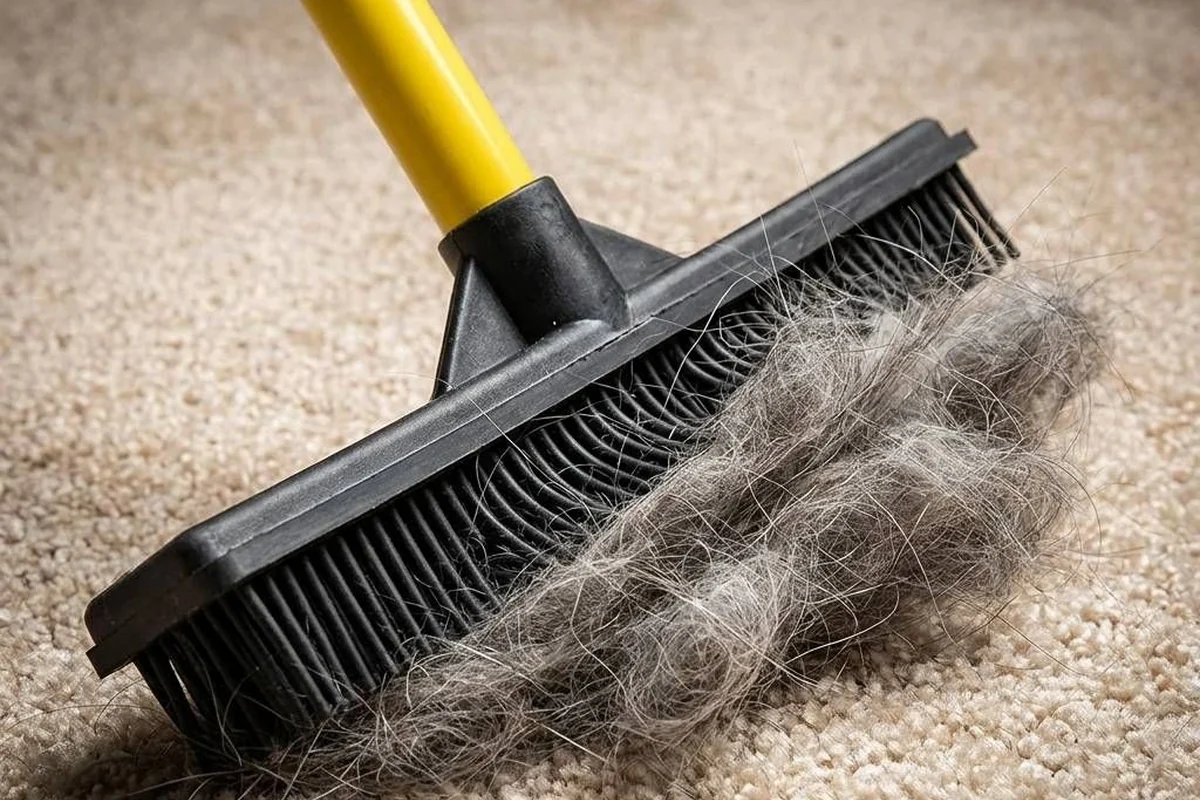
Pet hair has an impressive ability to turn a simple cleaning job into a collection of smaller ones.
There is fur across the living-room rug, another strip along the baseboards, loose hair drifting across the kitchen floor, and a few strands that the vacuum somehow left exactly where you started.
That is where a rubber pet-hair broom can make sense.
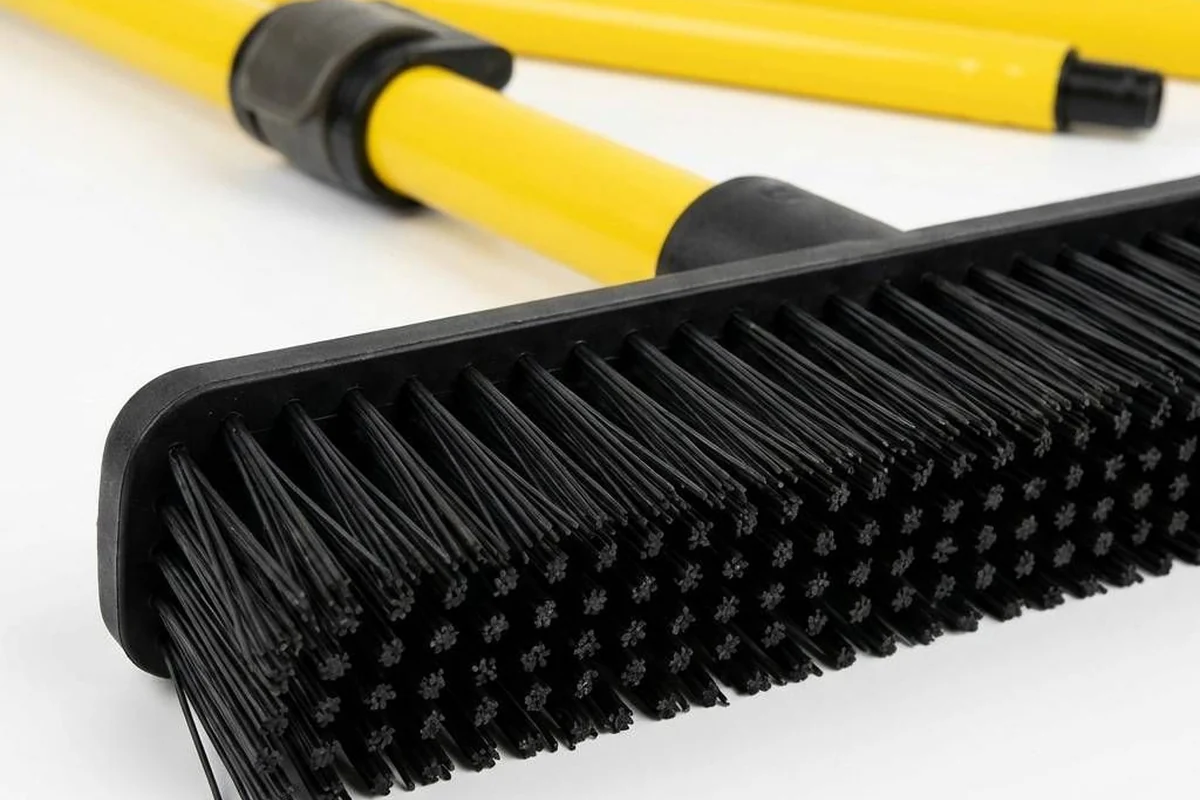
The FURemover Original 58″ Rubber Pet Hair Broom & Squeegee is not a replacement for every vacuum, mop, lint roller, or upholstery tool in the house. It is a reusable manual broom built around flexible rubber bristles, with an adjustable handle and a squeegee edge on the head. The 58-inch version uses a 12.5-inch-wide head and a telescoping handle that adjusts from about 34 to 58 inches.
Its best argument is much simpler than some of the advertising around pet-hair tools:
Sometimes loose fur is easier to gather than to vacuum.
Quick Verdict
The FURemover broom makes the most sense for pet owners who regularly deal with loose dog or cat hair across carpet, rugs, and hard flooring and want a reusable manual tool for gathering it.
Its biggest strengths are straightforward:
- the rubber bristles do not require disposable adhesive sheets;
- the long handle is more practical for floors than a handheld lint roller;
- it can gather hair into piles for pickup;
- the rubber head can be rinsed after use;
- the separate squeegee edge gives the tool another household function.
But there are also important limits.
It still requires manual effort. It does not vacuum up dust and debris. It will not be the right tool for every delicate, looped, high-pile, or handmade rug. And on a smooth hard floor with only a little loose hair, a microfiber mop or suitable vacuum may be faster.
So is it useful?
For the right kind of pet-hair cleanup, yes.
Is it the only cleaning tool you need?
No.
What the FURemover Original Actually Is
At first glance, it looks like an unusually wide broom.
The difference is the head.
Instead of traditional broom fibers, the FURemover uses rows of flexible rubber bristles. The 58-inch model also includes a squeegee edge and an adjustable handle, making it useful across several common household surfaces.
For pet owners, the interesting part is not really the word “broom.”
It is what happens when the rubber bristles are pulled across a surface with loose hair on it.
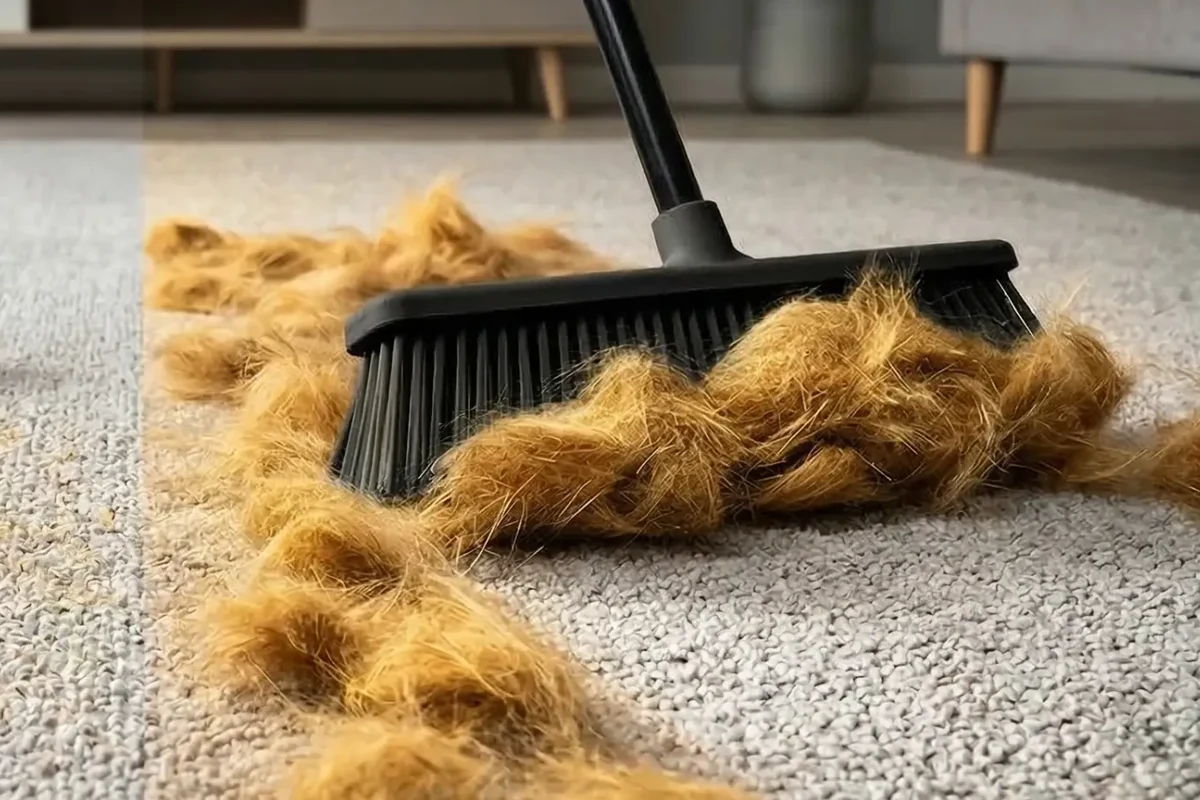
Rather than expecting a vacuum to pick up every strand in one pass, you can use the broom to bring scattered fur together and then remove the resulting pile.
That can be especially useful when hair is visible but does not want to cooperate with a normal quick vacuuming pass.
Where the FURemover Broom Makes the Most Sense
The broom is easiest to understand when you separate surfaces instead of treating the entire house as one cleaning problem.
A carpet is different from a kitchen floor.
A low-pile rug is different from a shag rug.
The strip beside a baseboard is different from the open center of the room.
The FURemover can be useful in several of those situations, but not necessarily in exactly the same way.
Carpet and Everyday Rugs Are the Most Obvious Use
Carpet is where a rubber pet-hair broom can feel most different from an ordinary broom.
Loose fur can sit on top of carpet, settle between fibers, or remain visible after a normal vacuuming pass.
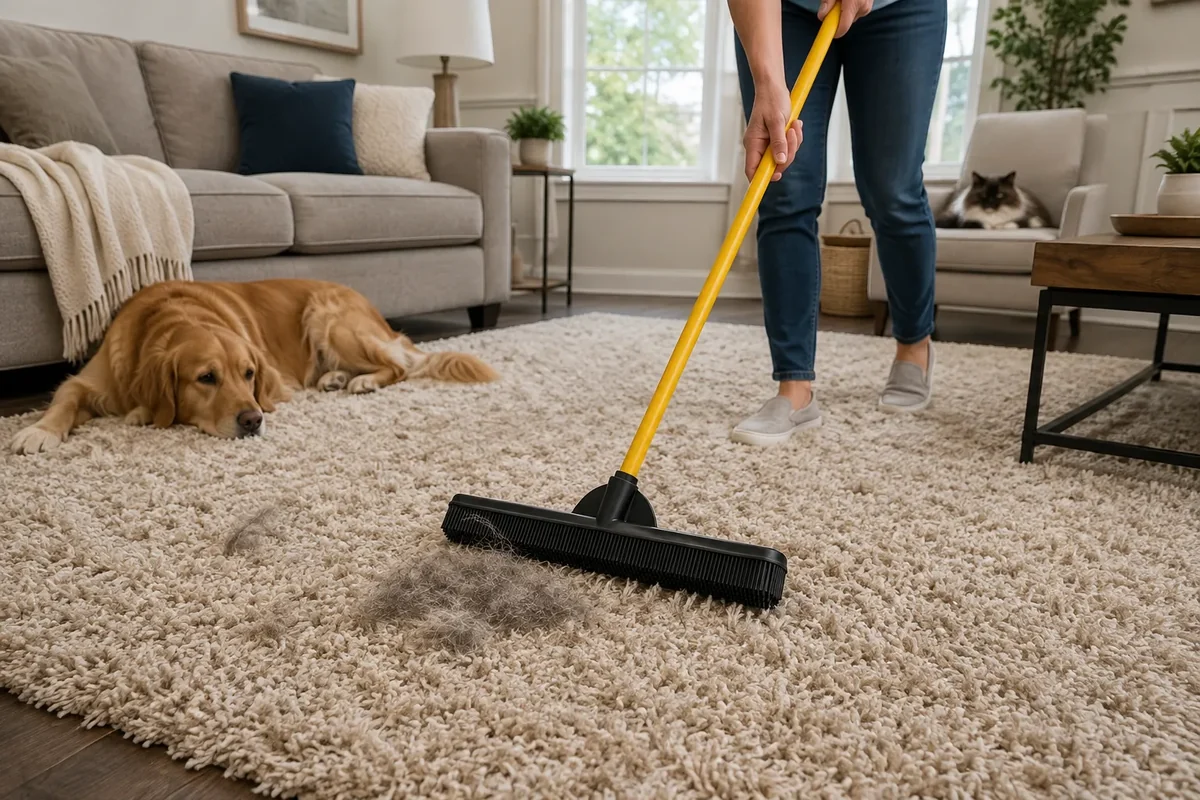
Using short, controlled pulls with the rubber head can bring some of that hair together into visible clumps that are easier to collect.
That does not mean you need to replace your vacuum.
The two tools do different jobs.
A vacuum is useful for picking up dust, crumbs, grit, hair, and other debris in one process.
A rubber broom is much more specialized. It manually works loose hair across the surface and gathers it.
In a pet-heavy room, one practical approach is to use the rubber broom where hair is especially stubborn and then vacuum the room normally.
If your main problem is fur embedded across ordinary carpet or rugs, see our How to Remove Pet Hair from Carpet and Rugs guide for the complete cleaning process.
High-Pile and Shag Rugs Need More Caution
This is where a broad claim like “works on rugs” becomes too simple.
Rugs vary enormously.
A dense low-pile synthetic rug may tolerate a rubber broom perfectly well.
A long shag rug may catch the bristles.
A looped rug can behave differently again.
Fringe and delicate edge construction add another complication.
So do not assume that because the FURemover works well on one carpet, it should be pulled aggressively through every rug in the house.
Test a small inconspicuous section first.
Use light, controlled movement.
If the rubber begins catching rug fibers, loops, or fringe instead of gathering pet hair, stop.
For long-pile rugs in particular, our How to Remove Pet Hair from High-Pile and Shag Rugs guide covers the safer approach in more detail.
What About Hardwood, Tile, and Vinyl?
The broom can also be used as a manual floor tool on compatible hard surfaces.
But usefulness depends on what is actually on the floor.
Imagine a kitchen with scattered dog hair drifting toward the cabinets.
A rubber broom can help bring those loose strands into one place without chasing them individually across the room.
Now imagine the same kitchen with crumbs, grit, dust, kibble, and pet hair.
A vacuum may be more convenient because it can pick up the mixed debris rather than simply gathering it.
And if the floor has only a light layer of loose hair, a dry microfiber mop may be all you need.
The point is not to find one winner.
It is to use the simplest tool for the mess in front of you.
For surface-specific guidance, see How to Remove Pet Hair from Hardwood Floors and How to Remove Pet Hair from Tile and Vinyl Floors.
The Long Handle Is More Important Than It Looks
A small rubber pet-hair brush can work extremely well in a car or on a sofa.
It is less appealing when the problem covers an entire living-room floor.
That is where the full-length FURemover has an advantage.
The 58-inch model uses a telescoping handle that adjusts from roughly 34 to 58 inches.
That means you can use it as a normal standing floor tool rather than spending the cleaning session kneeling beside the rug.
The adjustable length can also be useful when moving between a large open floor and smaller areas where a fully extended handle feels unnecessary.
There is still a tradeoff.
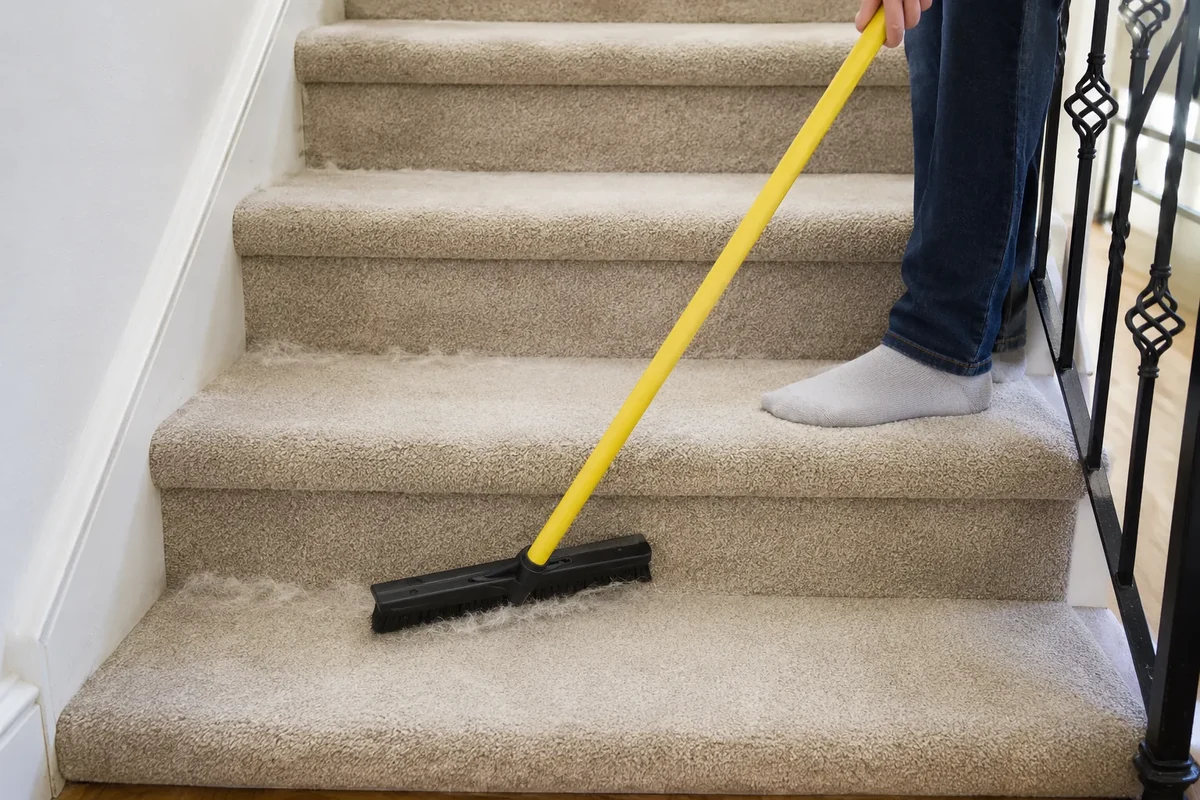
A long-handled broom is less precise than a small handheld tool around furniture legs, stairs, upholstery, or tight corners.
Use the long broom where reach matters.
Use a smaller tool where control matters.
The Squeegee Is a Separate Part of the Tool
The rubber bristles and squeegee should not be treated as the same thing.
The bristled side is what makes the broom useful for gathering loose hair and debris.
The built-in squeegee edge is designed for moving liquid on suitable surfaces.
That makes the broom more versatile, but the squeegee is not the reason it removes pet hair.
For routine fur cleanup, you are primarily buying the rubber-bristle side.
Think of the squeegee as an additional household function rather than a pet-hair feature that needs to be used every time.
FURemover Broom vs. Disposable Lint Rollers
This is where the old “financial review” idea actually has a useful point.
A traditional adhesive lint roller is consumable.
Every sheet you tear off is gone.
Eventually you need another roll or another refill.
A rubber broom does not work that way.
Once you own it, normal pet-hair collection does not require replacing sticky sheets every time you clean a rug or floor. The rubber head can be cleaned and reused.
That does not mean everyone will save some specific dollar amount.
There is no honest universal calculation.
One person might use a lint roller twice a month.
Another household with several shedding dogs might go through sheets constantly.
Prices also vary by brand, package size, retailer, and time.
But the underlying difference is real:
Lint rollers consume adhesive sheets; a rubber broom is a reusable cleaning tool.
For large floor areas, that alone can make the broom more sensible than trying to attack an entire carpet with sticky tape.
Lint rollers still have their place.
They are convenient for clothing, a small upholstered area, or a quick pass before leaving the house.
Nobody wants to use a 58-inch floor broom on a black sweater.
FURemover Broom vs. a Vacuum
This comparison gets unnecessarily dramatic online.
You do not need to choose a side.
The broom does one thing particularly well: manually gathers loose hair.
A vacuum does much more.
It can remove:
- hair;
- dust;
- crumbs;
- grit;
- fine debris;
- material the broom only moves around.
That makes a vacuum the more complete general floor-cleaning tool.
But a vacuum can still leave visible pet hair behind on some carpets or around edges.
In those spots, working the hair loose with a rubber broom before or after vacuuming can be useful.
Think of the FURemover as a companion tool for stubborn fur, not as a machine that makes vacuum cleaners obsolete.
It Can Also Reach Places a Full Vacuum Head Misses
One of the better uses for a long rubber broom is not necessarily the center of the room.
It is the few inches around everything else.
Pet hair tends to collect along baseboards, underneath the front edge of furniture, beside cabinets, around table legs, close to pet beds, and underneath accessible furniture.
A full-size vacuum head may pass close to those areas without actually reaching them.
The slim profile of a broom head can sometimes pull the fur outward so it can be collected normally.
We cover that problem separately in How to Remove Pet Hair from Baseboards, Corners, and Under Furniture.
What the Broom Does Not Do
A useful product review should also explain what you are not buying.
The FURemover does not collect debris inside itself.
Whatever you gather still needs to be picked up.
It does not replace wet floor cleaning.
It does not clean stains.
It does not remove pet urine from carpet.
It does not automatically make every rug safe to scrub.
It does not replace an upholstery tool when you are working on a small couch cushion.
And it does not eliminate shedding.
Your dog or cat is still going to produce more hair.
This tool deals with the hair after that happens.
Cleaning the Rubber Head Is Simple
One advantage of rubber bristles is that you can see when they need attention.
Hair may wrap around or sit between the rows of rubber.
Dust can accumulate.
After dry cleanup, pull off the loose hair and debris.
When the head needs a more complete cleaning, the rubber bristles can be rinsed with water.
Let the tool dry properly before putting it away.
There is no benefit to storing a dirty, damp broom in a closet simply because rubber itself tolerates water.
Basic cleaning also makes it easier to see what the bristles are doing the next time you use them.
Is the FURemover Broom Durable?
There is no responsible way to promise that a particular broom will last five years, ten years, or forever.
How long it lasts depends on use, storage, handling, and the individual product.
What we can say is that the cleaning head is reusable.
There are no disposable adhesive sheets to replace during normal use, and there is no powered brush roll inside the broom head.
That simplicity is appealing.
But “simple” is not the same as “indestructible.”
Avoid storing the tool carelessly, forcing the handle beyond its adjustment range, or dragging the rubber head across surfaces where it repeatedly catches.
Treat it like a reusable household cleaning tool, not shop equipment.
Who Is the FURemover Original Best For?
The full-size broom makes the most sense if most of these sound familiar:
- you have a dog or cat that leaves noticeable fur on floors;
- you regularly clean carpet or rugs;
- you have open areas where a long-handled tool is more practical than a handheld brush;
- your vacuum gets most of the mess but sometimes leaves visible hair behind;
- you would rather use a reusable rubber tool than cover large areas with disposable lint-roller sheets;
- you want something simple that does not need electricity, batteries, bags, or refills for normal use.
That is the core use case.
Who Might Not Need It?
You may not get much value from the full-size broom if your pet sheds very little.
The same is true if almost all of your pet-hair problem is on clothing, small couch cushions, car seats, bedding, or other compact fabric surfaces.
A smaller handheld pet-hair tool will usually be easier in those places.
And if your house is mostly smooth hard flooring with only occasional loose fur, a vacuum or microfiber mop may already handle the job well enough.
There is no reason to buy another cleaning tool just because it exists.
What If You Have an Expensive or Delicate Rug?
Do not assume every rug is compatible simply because the broom has soft rubber bristles.
Test first.
That matters for handmade rugs, antique rugs, long-pile rugs, shag rugs, looped construction, rugs with loose fringe, and delicate fibers.
Try a small inconspicuous area and watch the rug itself, not just the pet hair.
If fibers begin catching, stretching, fuzzing, or pulling toward the broom, stop.
With a valuable rug, the manufacturer's care instructions or advice from a qualified rug-cleaning professional should take priority over generic cleaning advice.
Does It Make Financial Sense?
Potentially, but not because of a magical return-on-investment formula.
The argument is mostly about reusability.
If you currently use disposable lint rollers for large carpeted areas, moving much of that work to a reusable rubber broom may reduce how many adhesive sheets you use.
How much money that saves depends entirely on your household.
If you barely use lint rollers now, the savings may be trivial.
If you regularly tear through refills trying to clean rugs or floors, the difference may be much more noticeable.
That is a more useful way to think about value than inventing a five-year cost projection based on somebody else's pet, house, and shopping habits.
FURemover Broom FAQ
Does the FURemover broom replace a vacuum?
No. A vacuum is a general floor-cleaning tool that picks up hair, dirt, dust, crumbs, and other debris. The FURemover broom is more specialized. It can help gather loose or stubborn pet hair manually, especially on carpet and rugs, and can work alongside a vacuum rather than replacing it.
Can you use the FURemover broom on hardwood floors?
The broom is designed for wood and other hard flooring as well as carpet. Use a clean broom head and follow the care requirements for your particular floor. If you are unsure about a finish or unfamiliar tool, test a less noticeable area first.
Can you use it on tile and vinyl?
Yes, those are among the common surfaces the FURemover broom is designed to handle. On smooth flooring it can help gather loose pet hair, although a microfiber mop or vacuum may be faster when the amount of hair is small or mixed with other debris.
Is the FURemover broom safe for every rug?
No tool should be assumed safe for every rug. Construction, fiber type, pile height, loops, fringe, and condition all matter. Test the rubber broom on a small inconspicuous area and stop if it catches or pulls rug fibers. Be especially cautious with high-pile, handmade, antique, or delicate rugs.
Is a rubber broom cheaper than using lint rollers?
It can be over time if you currently use a lot of disposable adhesive sheets for floor cleaning, but there is no universal savings figure. The important difference is that the broom head is reusable while traditional lint-roller sheets are consumable.
Final Verdict: Is the FURemover Broom Worth It?
The FURemover Original makes the strongest case for itself when pet hair is a floor problem.
It gives you a reusable way to work loose fur across carpets, rugs, and compatible hard surfaces without bringing out a disposable adhesive sheet for every cleaning session.
The long handle makes sense for rooms.
The rubber bristles make sense for gathering hair.
The squeegee is a useful extra.
And the fact that the broom is manual can be an advantage when you simply want to pull a stubborn patch of fur out of a carpet instead of setting up another machine.
Its limits are equally straightforward.
It does not vacuum debris.
It takes physical effort.
It is oversized for many upholstery jobs.
And a rubber broom should never be treated as automatically appropriate for every delicate or high-pile rug.
For households that regularly find dog or cat hair across carpets and floors, it can be a useful addition to the cleaning closet.
For homes where pet hair is mostly confined to clothing or a few small fabric surfaces, a smaller tool may make more sense.
That is a much better reason to buy it than a promise about saving a particular number of dollars.
Affiliate note: As an Amazon Associate I earn from qualifying purchases. Price and availability can change.
Check current price and availability on Amazon
For more surface-specific advice, browse the Pet Hair Cleaning Guides.